Road kills lines all of the roads out here. Primarily kangaroos and wallabies, but also feral pigs, foxes and small furry things. These attract raptors, so inevitably many of them become roadkill themselves. I can't understand how people can plow through them, just slowing down as you approach gives them time to take to the air. The birds were primarily Black Kite, but there were good numbers of Wedge-tailed Eagles including one pair that were feeding a young bird in a nearby tree.
Monday, May 13, 2013
Blackall to Winton
Road kills lines all of the roads out here. Primarily kangaroos and wallabies, but also feral pigs, foxes and small furry things. These attract raptors, so inevitably many of them become roadkill themselves. I can't understand how people can plow through them, just slowing down as you approach gives them time to take to the air. The birds were primarily Black Kite, but there were good numbers of Wedge-tailed Eagles including one pair that were feeding a young bird in a nearby tree.
Sunday, January 20, 2013
Wee Jasper - Yass Road
Headed home from Wee Jasper towards Yass, this Wedge-tailed Eagle flew low across the road in front of me, a White-faced Heron dangling from its talons, and landed in a tree some distance from the road.
The Wedge-tailed eagle is Australia's largest bird of prey and one of the largest eagles in the world, with females weighing up to 5.3 kilos and having a wingspan of 2.5 meters. Females are generally larger than males. Their diet reflects available prey, with rabbits being the primary food source in most parts of their range. Under ideal conditions they can lift 50% of their body weight.
They have been known to attack paragliders, but as far as I know have not carried any off.
Sunday, October 7, 2012
Rylstone Weir
Rylstone Weir is a large lake on the Cudgegong River that supplies water to
Rylstone and Kandos. The track to the weir is on the northeastern edge of Rylstone. From central Rylstone, take Louee St to the north edge of town just before the bridge. Turn right into Dabee St, then left into Tongbong St which turns right and becomes Rylstone Dam Rd. Take this to the top of the rise and park along the side of the road near the locked gate. The pedestrian gate gives access to the track that winds up to the weir, and continues on to the headland on the far side.
A pair of raptors were circling and calling in the distance, and White-Browed Scrub Wrens and Superb Fairywrens scolded from the scrub. Rabbits broke from cover as we passed, and Wombat scat littered the path.
On the near side of the lake thick reeds and high grass made it difficult to see birds close by, but out on the water were Great Crested Grebe, Musk Duck, Darter, Black Swan, Little Pied Cormorant, Little Black Cormorant, Great Cormorant, Purple Swamphen, Eurasian Coot, Maned Duck and Pacific Black Duck. Reed Warblers could be heard, but not seen.
Tree Martins and Welcome Swallows buzzed the water in a search for insects.
Paddling across the stream in bare feet, we headed up the hill where we were more on a level with the treetops. There were many White-plumed Honeyeaters, one tending a neatly woven nest.
Eastern Yellow Robin were also plentiful, and similarly seemed to be tending nests in the low shrubs.
A Brown Treecreeper circled the tree trunks.
In the distance a Little Eagle soared, harried by smaller birds, but never coming close.
Birds that we saw, but only managed record shots, or no shots at all were an Azure Kingfisher, a flash of blue over the river; a pair of Sacred Kingfishers investigating a hollow high in a dead tree, an Olive-Backed Oriole resting briefly in high branches; two White-browed Babblers who called from within the blackberries before fleeing to the far side of the fence line; a Fuscous Honeyeater hawking for insects; Willie Wagtails; Noisy Miners; White-bellied Cuckoo-Shrike and Black-Faced Cuckoo-Shrike; Rufous Whistler; Laughing Kookaburra; Crested Pigeon; Grey Shrike-thrush; Australian Magpie; Magpie-lark; and Peaceful Dove.
Sunday, April 29, 2012
Goolawah Regional Park
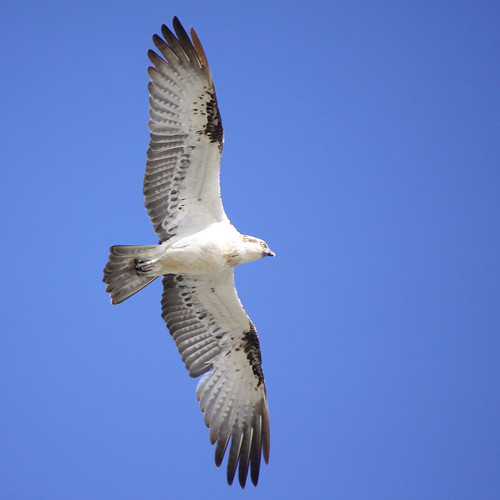
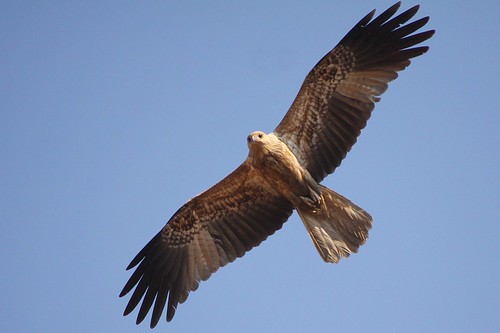
From top to bottom: Brahminy Kite, White-bellied Sea Eagle, Square-tailed Kite.
In 2010 Goolawah State Park was re-designated Goolawah National Park and Goolawah Regional Park, and the campground I’ve been visiting for some years with my dogs became part of the national park. The Regional Park is a 60 acre strip between the road and the beach, with the national park to the north and Limeburners Creek National Park forming its southern edge.
Given that Australia has one of the highest levels of pet ownership in the world with two thirds of families having a pet we have some of the most restrictive laws controlling them. I’ve always been entertained by the fact that I can have my dog with me in the five-star Trump International Hotel on the strip in Las Vegas, but not in most local caravan parks. At the tail end of the Easter holidays there were around a dozen families with their dogs at Goolawah. In addition to the general rules governing dog ownership in NSW under the Companion Animals Act, at the Park dogs must be desexed and confined at night. There was one dog that wandered about, a half-grown pup whose owners spent a lot of time in the surf, but it didn’t cause any problems and the other fifteen or so dogs ran and swam with their owners on the beach and collapsed tired and happy beside the campfires of an evening. One family have been staying here for four weeks every May for forty years, always with their dog, including their current pet Joe – a wonderful big guy never far from his owner’s knee.
Birds were plentiful, including doves, ducks and quail at ground level, along with snakes and lizards.
Friday, October 8, 2010
Horse Pond
Tuesday, October 5, 2010
Broome Bird Observatory
The tour gave us a full day on Roebuck plains station, which involved a range of habitat including tropical wetland, pindan woodland and grassland, and the microhabitats around natural waterholes and man-made bore dams.
Saturday, October 2, 2010
Gantheaume Point
We wandered out to Gantheaume Point at first light to capture the early sun on the red rocks. At the communication tower a pair of Osprey were ignoring the cry of two fledged chicks, though this bird looked as though it was drying off after a recent fishing trip.
On the road out a collared sparrow hawk watched the scrub from the powerlines.
Thursday, September 30, 2010
Broome Port
Saturday, June 26, 2010
Fairview Park, Costa Mesa
Lots of hummingbirds and house finches, california towhees, black phoebes and say's phoebes, and four Cooper's Hawks - a family group.
Tuesday, May 4, 2010
Walsh Point
Just as I pulled up in the car at Walsh Point, where the north and south arms of the Hunter River meet, an Osprey flew in to land on a light pole. However I needed a new battery, and by the time I got the camera organised he was gone. I walked along the river with the dogs, hoping for gull-billed terns but only finding crested tern and silver gulls. Then my Osprey overtook me flying up the middle of the river. They have previously nested in the area, and it is the spot where I’m most likely to see them, but it happens rarely enough to be a welcome sight. He banked and turned immediately overhead, giving me some nice images.
Monday, April 26, 2010
Sunday, March 21, 2010
Manning Point
Last weekend I went to Manning Point for a 24 hour camp with the dogs, lured by the promise of good weather, which didn’t eventuate. So this weekend we went back again. We’d barely set up the tent and put the billy on for tea when this young Square-tailed Kite circled the campground.
The Square-tailed Kite Lophoictinia isura is a medium sized raptor endemic to mainland Australia. It is a species which can spend many hours on the wing with little active flight and can be observed either soaring high over open country, scrub or woodland or close to tree tops and through the tree canopy. It is a specialist hunter of passerines, especially honeyeaters and insects in the tree canopy, picking most prey items from the outer foliage by skimming and circling just above or below the tree tops.
The paperbarks and eucalypts in the area were in full flower, attracting lorikeets and honeyeaters in the hundreds, so it would have been a top spot for him, though I’m pleased I didn’t have to witness his lunch.
The Square-tailed Kite is sparsely distributed throughout the Australian mainland, primarily within 250km of the coast and generally absent from treeless inland areas and from dense forests.
Monday, January 4, 2010
Walsh Point Reserve
A Swamp Harrier cruised past with a pair of Masked Lapwing in noisy pursuit.
(Windows Live Writer has a handy insert map feature)
Thursday, September 24, 2009
The Basin
In the event, while there were plenty of terns, for the most part they stayed well out in the centre of the Basin. Some feral pigeons, a raven and this immature kite were the only birds that came within photography range.
The dogs were hyped up by the wind and raced each other on imaginary figure eight tracks.
Bird List:
Black-shouldered Kite (Pictured Above)
Great Crested Tern
White-fronted Tern
Little Tern
Silver Gull
Australian Raven
Rock Dove
Australian Pelican
Superb Fairywren
Golden Headed Cisticola
Tuesday, September 1, 2009
Barrier Highway
Thursday, August 13, 2009
Carrington off-leash area
Tuesday, August 4, 2009
Kooragang Island
Saturday, August 1, 2009
Stockton Channel
We generally park just after the bridge and walk along the mangroves before crossing to the beach.
It was afternoon and the mangroves were backlit, but as the tide was coming in it meant walking out through the squishy mud to get on the sunny side of the thornbills, brown honeyeaters and gerygones I abandoned any thought of photos of the mangrove inhabitants.
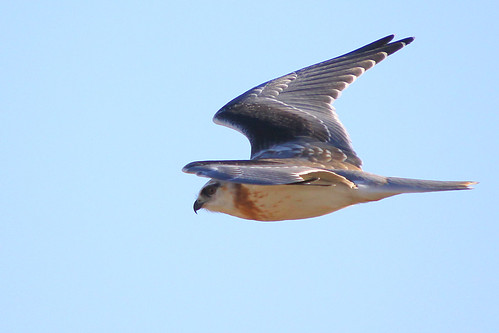
Luckily there were some raptors out - though the sea eagles stayed well in the distance over the river. There are twenty four diurnal raptor species native to Australia. The Swamp Harrier (Circus approximans) belongs to the Family Accipitridae, and the Australian Kestrel (Falco cenchroides) to the Family Falconidae.
Australian Kestrels are sometimes called Nankeen Kestrels after the red-brown cloth 'nankeen'. When hunting they plunge head first toward the ground, pulling out of their dive at the last moment to strike with their feet. Kestrels have specially adapted eyes which enable them to see ultra violet light, giving them the ability to see scent and urine trails which are invisible to humans, and gives them the advantage when hunting to know where to expect to find their prey. Adult male kestrels are identifiable by their grey heads and tails, while adult females have a brown head and rufous tail. The female birds are generally larger than the males.
The Swamp Harrier is largely dark brown, becoming lighter with age, and has a distinct white rump. Females are larger with rufous underparts, while the smaller male is lighter underneath. It hunts by flying slowly, low to the ground, on upswept wings. When hunting they 'quarter', which means that they systematically search for prey covering the ground thoroughly. The swamp harrier is widespread throughout Australia, and is usually found in wetlands and well-watered open country.
Sunday, July 26, 2009
Crescent Head
Threats:
- Removal of large trees near the coast that could be used as nest sites.
- Disturbances to water quality that increases turbidity in feeding areas.
- Ingestion of fish containing discarded fishing tackle.
Saturday, July 11, 2009
Shoal Bay
I was suprised, however, to see a flock of around fifty plus pied heron fly in.
Bird list:
Whistling Kite Haliastur sphenurus (pictured above)
Black Kite Milvus migrans
Square-tailed Kite Lophoictinia isura
Pied Heron Ardea picata
Rainbow Bee-eater Merops ornatus
Magpie Lark Grallina cyanoleuca