Showing posts with label Dicaeidae. Show all posts

Saturday, April 10, 2010

Black Spring TSR

On Easter Saturday, a walk through the Black Spring TSR was hot and dusty. It is a remnant of the once vast Grassy White Box Woodland that covered the area, and runs alongside the road about 6.5k south of Barraba. Maureen and I trudged the 3k to the end without coming across water in any of the three waterholes. Heading up to the top of the ridge we were snapping Mistletoe birds when a  Speckled Warbler came down to scold us. It followed us as we worked our way uphill.

IMG_8461_1Mistletoebird - female

IMG_8425_1

Speckled Warbler

A number of tiny birds were chasing insects in the top of the eucalypts. Buff-Rumped and Yellow-Rumped Thornbills, White-Throated Gerygone and Weebills.

IMG_8526_1Weebill

Australia’s smallest bird, Weebills are a bit of a challenge for photographers, as they move fast high in the trees. I managed to get my best shots yet of the little cutie. On the way back to camp we stopped to watch several Jack Winter catching insects on a large mistletoe clump.

IMG_8304_1Jacky Winter

Wednesday, December 16, 2009

Kitchener


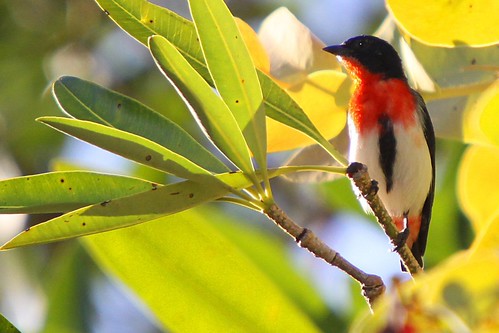
Mistletoebird

I came across this perfectly posed mistletoe bird in a patch of dense wattle scrub. I was walking with the Sigma 50-500 lens, with settings for the bright sunlight that we had been in moments before. I took several shots on the 'custom' position that I had set up for birding but this was giving me underexposed images. My flash unit was back in the car, and it was a bit much to hope that he'd wait long in this position. So I just flicked the dial to full automatic, allowing the on-camera flash to pop up. This was slow-speed flash and there was sufficient ambient light to give a blurred outline to the moving bird.
He jumped noticably when the flash went off, and stopped singing to concentrate on me; birds are affected by flash light. However flash when used as a fill to reduce shadows and add a catch light produces wonderful bird images.
Secrets of Digital Bird Photography offers a range of tips on the effective use of flash in bird photography.

Friday, June 19, 2009

Rapid Creek


Casuarina Coastal Reserve runs for an 8km stretch between the estuaries of Rapid Creek and Buffalo Creek. Bike paths and walking tracks pass on one side sandy beaches, dramatic sandstone cliffs and shady casuarina trees, and on the other patches of woodlands, monsoon forests, mangroves and paperbarks.

Rapid Creek is the southernmost part of the reserve. On a cool (for Darwin) morning I walked from the Rapid Creek pedestrian bridge to Dripstone Cliffs, and easy 3k return trip. There are regular Ranger-guided walks through the reserve, which might help me identify some on the plants I'm photographing.

It was quite windy, which made locating birds a bit more of a challenge, but I came across a very obliging group of lemon-bellied flycatchers whose posed singly and in groups in a small tree, a nearby vine and the mangroves. I could have filled a card with their antics alone.

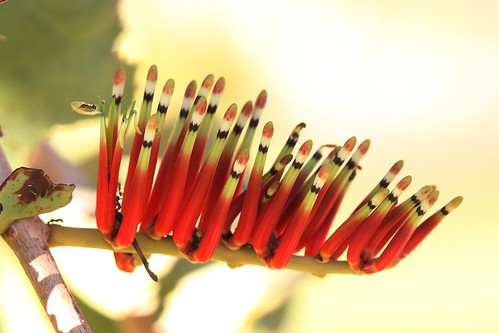
Brown honeyeaters were the most dominant honeyeater species. Raptors soared above the flying fox colony. Woodswallows perched wing to wing in groups of twenty or more. Tiny peaceful doves were camouflaged in the grass, The mistletoe was in full blossom - amazing flowers, matched by their associate mistletoe bird.
Bird List:
Mistletoebird Dicaeum hirundinaceum (pictured above)
Black Kite Milvus migrans
Brahminy Kite Haliastur indus
Peaceful Dove Geopelia striata
Bar-shouldered Dove Geopelia humeralis
Galah Cacatua roseicapilla
Sulphur-crested Cockatoo Cacatua galerita
Sacred Kingfisher Todiramphus sanctus
Brown Honeyeater Lichmera indistincta
Lemon-bellied Flycatcher Microeca flavigaster
Magpie Lark Grallina cyanoleuca
Varied Triller Lalage leucomela
Black-faced Cuckoo-Shrike Coracina novaehollandiae
White-bellied Cuckoo-Shrike Coracina papuensis
Yellow Oriole Oriolus flavocinctus
White-breasted Woodswallow Artamus leucorhynchus
Long-tailed Finch Poephila acuticauda
Crimson Finch Neochmia phaeton
Welcome Swallow Hirundo neoxena