Showing posts with label Artamidae. Show all posts

Monday, May 13, 2013

Winton

Crested Pigeon
We checked into the Matilda Country Tourist Park, where we were given a great spot under a group of trees, and set up our 'big camp', a screened gazebo under which we could have a little tent for sleeping, Dusty's crate, a kitchen table, and a chair and coffee table. It was HOT, and flies were BAD, so we were the envy of those who had to choose between the caravan and the open.

Birding was good from the gazebo with Yellow-throated Miners, White-plumed Honeyeaters, and Inland Thornbills foraging in and under the trees, and a dripping tap attracting a steady stream of birds.

Apostlebird
Of an evening birds gathered on the powerlines to bath in pools left behind by the sprinkler.

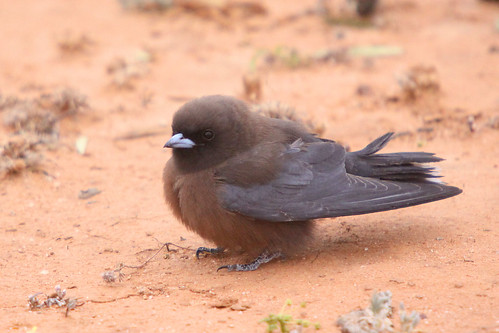
Black-faced Woodswallow

Diamond Dove

White-plumed Honeyeater

Zebra Finch

Galah

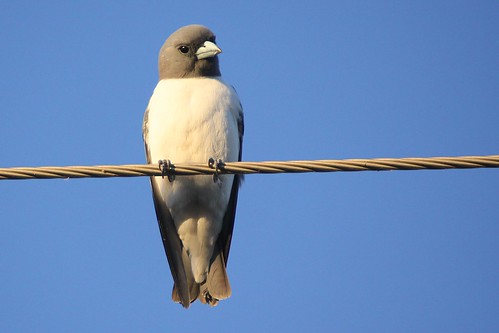
White-breasted Woodswallow

Blackall


Blackhall has a "Bird Watching Trail" between anabranches of the Barcoo River, marked by this rather splendid The Eagle and Nest sculpture by Richard Moffat. The sculpture is made of  railway dog spikes and timber and bolts from the old bridge. The trail is also a fitness track with some rather state-of-the-art fitness equipment along the way, but luckily it was as well used as most of these things are so there was no disruption to the bird watching.

Pale Headed Rosella
The Pale Headed Rosella was my nemesis bird of the trip. There were several on the trail, and good numbers in several other places on the trip, but nowhere did I manage a decent photo of one. Trail bird list:

  • Wedge-tailed Eagle    
  • Whistling Kite               
  • Crested Pigeon           
  • Budgerigar                   
  • Pied Butcherbird         
  • Australasian Magpie  
  • Apostlebird
  • Yellow Rumped Thornbill 
  • Pale Headed Rosella


White-breasted Woodswallow
In the caravan park Woodswallows used the sprinklers to hawk for insects, and a Spotted Bowerbird picked berries in a shrub on the other side of the fence.


Monday, March 25, 2013

Barraba

Dusky Woodswallow

Leaden Flycatcher

Jacky Winter

Barraba was one of the first regions to map and publicise Bird Routes and to conserve and maintain the travelling stock reserves as the cornerstone of a nature-based tourism industry. The routes are well signposted, and detailed descriptions of the routes and bird checklists are available from the visitor information centre.

However keep in mind that the birds don't read the brochures. My first stop was not mentioned in any of the guides and trip reports and yet gave close-up views of Spotted Pardalotes, Willie Wagtails, Brown-headed Honeyeaters, Dusky Woodswallows, Jacky Winter, Yellow-rumped Thornbill, Leaden Flycatchers, and White-plumed Honeyeaters. The spot was Adam's Lookout.

I headed west on the Trevallyn Road to Plumthorpe TSR, where the water was flowing strongly in the Manilla River, with signs that levels had recently been very high. The White Box trees were just starting to flower, with Brown-headed Honeyeaters  and Striped Honeyeaters gleaning among the leaves. Dollarbirds returned to perches high in a dead tree, an Eastern Yellow Robin flew in close, King and Red-winged Parrots flew overhead, and Striated Pardalotes kept to the tops of the trees.

At Little Creek TSR  Noisy Miners called an alarm, and a White-throated Gerygone flitted in the creek-side shrubs. The grass here was also close to waist height which made walking fairly unpleasant, and combined with the vandalised picnic facilities didn't encourage me to linger.

Brown-headed Honeyeater
I drove the Cobbadah-Upper Horton Route but there was little in flower, and it was mid-afternoon, so I added only fleeing Grey-crowned Babblers and a Pacific Heron to my day list.


Friday, April 16, 2010

Stockton Channel

070_1

The Woodswallows are gathering in large flocks, so they may not be with us for many more days. They breed from the Andaman Islands east through Indonesia and northern Australia and spend their summers further south.

Though called Woodswallows they belong to the family Artamidae, which also includes butcherbirds, currawongs and the Australian Magpie. And although they have a brush tipped tongue like honeyeaters they are insect eaters, catching insects on the wing.

Sunday, April 11, 2010

Stockton Channel

020_1

White-Breasted Woodswallows caught in a shaft of light in front of the storm clouds – on our walk along Stockton Channel. These guys should be heading north soon.

Thursday, April 8, 2010

Barraba Birding Routes

IMG_8594_2

Barraba is one of the best bird watching regions in New South Wales, and was the first area in Australia to produce a guide to the local birding routes. The Bird Routes utilise old droving roads now known as travelling stock routes and all 14 are signposted. Most of the Travelling Stock Reserves allow camping, though few have facilities. The TSRs generally have permanent water. Over 190 species of birds have been seen in the Barraba region, including the endangered Regent Honeyeater and the vulnerable Turquoise Parrot. Barraba is also the home of the endangered Boronia ruppii, a rare plant species only found here.

So I set off on Good Friday for a weekend in the region with the Hunter Bird Observers, with all my camping essentials packed and the dogs in Angie’s capable hands.

Tuesday, December 8, 2009

Stockton Channel


White-breasted Woodswallow

It was a rather gloomy morning, an hour after sunrise and there was no light to speak of. But that didn't dampen the spirits of this woodswallow who performed his wing-stretching, tail-wagging courtship display for some minutes. The girls, however seemed more interested in an insect breakfast than love making.

Steve has put together a slide show of a sequence he captured at Belmont Lagoon.

Wednesday, September 9, 2009

Bourke to Nyngan


We left Bowra Station after lunch, and wanted to get to Nyngan in time for the roast of the day at the RSL club, so most of the bird spotting was done at 100kmph.
However there were two moments of note. First was the amount of water along the road near Bourke. Long puddles attracted large number of birds including choughs and apostlebirds, and the green grass and herbs provided food and cover for many more. Second was the emu bush in bloom over a 20 km section between Bourke and Nygan which held literally thousands of woodswallows which flew up in flocks of 50 to 100 birds as we passed.
Bird list:
Masked Woodswallows (pictured above)
Apostlebird (pictured above)
Letter-winged Kite
Whistling Kite
Black Kite
Australian Kestrel
Australian Raven
Australasian Magpie
Wedge-tailed Eagle
Black-faced Cuckoo-shrike
White-breasted Woodswallow
White-browed Woodswallow
Cockatiel
White-winged Chough
Galah
Red-winged Parrot
Crested Pigeon

Windorah

Our first night out of the desert we spent in Windorah, the name is based on the Aboriginal word for 'place of large fish' after Cooper's Creek. Charles Sturt named Cooper's Creek, describing it as a 'fine watercourse' which he would have liked to call a river, but felt he could not, as it had no current.

The caravan park and the camping area on the creek were both crowded with people headed to the Birdsville races, but we were able to convince the publican to let us camp on the lawns behind the hotel. However as the others started setting up tents, I caught sight of the motel units ... The others gave me a hard time about my deficiencies as a 'dune warrior' but they knocked on the door one by one to read in my light, or boil my kettle.

Honeyeaters fossicked in the garden shrubs, apostle birds argued about family matters, woodswallows filled the sky, and swallows in their hundreds came and went from nests under the eaves.

We started off to do some birding along the 12 km nature drive from Windorah along Cooper's Creek, but the birds were tucked away out of the strong winds, which made good photos impossible in any case.

Bird list:

White-breasted Woodswallow (pictured above)
House Sparrow
Welcome Swallow
Magpie Lark
Black Kite
Fairy Martin
Yellow-throated Miner
Corella
Galah
Australian Raven
Australasian Magpie
Willie Wagtail
Apostlebird
Crested Pigeon
Red-winged Parrot
Peaceful Dove
Pelican
Pacific Heron
Budgerigar
Black-fronted Dotterel
Great Egret
White-plumed Honeyeater
Cockatiel
Brown Falcon
Wedge-tailed Eagle
Australian Pratincole

Bowra Station

Little Woodswallow
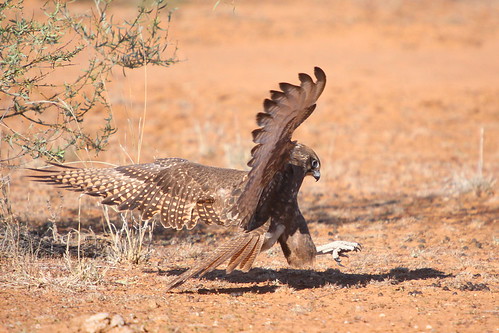
Brown Falcon
Bowra Station is justifiably known as one of Australia's 'birding hotspots'. Formally privately owned by a couple who encouraged birdwatchers, it is in the process of being purchased by the Australian Wildlife Conservancy using a combination of government grants and private donations. Not all of the Conservancy's properties are regularly open to visitors so birders are anxiously waiting to see what the policies will be at Bowra.

The afternoon we arrived was heavily overcast, making conditions difficult for bird photography. We settled down beside the homestead lagoon to watch large flocks of ibis test out various trees for suitability as a night time roost. They eventually decided against this spot, and all flew off into the dusk. We had some light rain over night, but the next day dawned clear.

Around the homestead and its lagoon were ibis, stilt, ducks, heron, dotterel, swallows, flycatchers, woodswallows, babblers, tree creepers, parrots and an active bowerbird bower. No sign of the Grey Falcon which reportedly visits the home lagoon, but it had not been seen for some weeks - since the young fledged.

We went out to Sawpits Waterhole spotting Bourke's Parrots just where the sign said they would be under the mulga, and watching a Spotted Bowerbird take a lengthy bath. Ringnecks were involved in a noisy courtship routine, and the whistlers' loud, melodious song was heard along the banks. Honeyeaters defended choice clumps of eucalypt blossoms.

Near the Main Creek crossing we pursued Halls and Grey-crowned Babblers, waiting for them to sit still long enough to have their portrait taken. The Button Quail didn't hang about either. The dozens of woodswallows searching for insects on the eucalypts were more obliging. A juvenile even came and sat near us on the ground, presenting several angles to ensure a flattering image.

At Stony Lookout we saw two Chestnut-breasted Quail Thrush, and in following them came across a Red-backed Kingfisher and male and female Red-capped Robins, and Slaty-backed Thornbills. We could hear the Crested Bellbird but could not locate it.

Back at the homestead to pack up camp, Chestnut-crowned Babblers searched for insects at the edge of the lagoon, and a Restless Flycatcher hovered over the water.

Bird List:

Emu
Grey Teal
Hardhead
Australian Wood Duck
Pacific Black Duck
Australian Pelican
Little Black Cormorant
Australasian Darter
White-necked Heron
Great Egret
Straw-necked Ibis
Yellow-billed Spoonbill
Royal Spoonbill
Whistling Kite
Wedge-tailed Eagle
Black-shouldered Kite
Black Kite
Nankeen Kestrel
Brown Falcon
Australian Hobby
Little Button-quail
Black-tailed Native-hen
Common Bronzewing
Diamond Dove
Crested Pigeon
Peaceful Dove
Little Corella
Galah
Major Mitchell's Cockatoo
Mallee Ringneck
Blue Bonnet
Red-winged Parrot
Red-rumped Parrot
Bourke's Parrot
Mulga Parrot
Budgerigar
Laughing Kookaburra
Red-backed Kingfisher
Sacred Kingfisher
Brown Honeyeater
White-plumed Honeyeater
Little Friarbird
Yellow-throated Miner
Singing Honeyeater
Noisy Friarbird
Spiny-cheeked Honeyeater
Striped Honeyeater
Black-faced Cuckoo-shrike
Grey Shrike-thrush
White-winged Triller
Australian Raven
Welcome Swallow
Tree Martin
Fairy Martin
Willie Wagtail
Jacky Winter
Red-capped Robin
Crested Bellbird
Rufous Whistler
Grey-crowned Babbler
Hall's Babbler
Chestnut-crowned Babbler
White-winged Fairy-wren
Splendid Fairy-wren
Inland Thornbill
Slaty-backed Thornbill
Southern Whiteface
White-browed Treecreeper
Brown Treecreeper
Magpie-lark
White-winged Chough
Apostlebird
White-breasted Woodswallow
White-browed Woodswallow
Masked Woodswallow
Black-faced Woodswallow
Little Woodswallow
Grey Butcherbird
Pied Butcherbird
Australian Magpie
Spotted Bowerbird
Australasian Pipit
Zebra Finch

Tuesday, September 8, 2009

Mt Dare

Black-faced Woodswallows (by Alwyn)

Budgerigars (by Alwyn)


Crested Pigeons (by Alwyn)


We met up with the others at Mt Dare, to start the Simpson Crossing. A steak dinner, a catch up with the various travel experiences of the others and cultivating the friendship of Chester, the hotel dog, occupied the evening. We gained agreement to a late-ish start so that we could do some birding at the dam and bore overflow at first light. Our efforts were well rewarded.

Huge flocks of budgerigars, galahs, zebra finches, corellas and red-tailed black cockatoos perched on every available tree waiting a turn at the water. White-breasted and black-faced woodswallows circled and returned to favourite branches. Honeyeaters fed on the garden shrubs. My laptop died before I had copied more than 4 of 14 folders to an external hard drive, I was able to recover the files from the card in the 30D with the wide angle, but not from the 50D which I was using for bird photography. So most of my birds from the trip are gone. I've posted some from Alwyn here to give an idea of the feast and famine situation with birds in the desert. Find water and you'll find birds.

Heading to Dalhousie Springs, we stopped at Blood's Creek and then at 3 O'Clock Creek. At Blood's Creek we saw yet another flock of Zebra Finches - these are tough little birds, able to eke out a living in the most arid landscapes. Blood's Creek was an important waypoint for both the Overland Telegraph and the Ghan Railway. In 1901 the Government put down a 2002 ft bore and a giant windmill which still spins slowly today, though there is little water available on the surface. Legend has it that when a traveller died here, they only had enough whiskey crates to make a short coffin with an open end and had to bury the man with his legs sticking out of the end of the box.

We stopped at 3 O'Clock Creek for a closer look at the Red Mulga or Minniritchi (Acacia cyperophylla). Also in the area were Coolibah, mentioned in Waltzing Matilda, Witchety Bush, amongst whose roots the tasty grubs can be found and Dead Finish, a wattle with such survival skills that it is said that when it dies everything is over.

Fairywrens and grasswrens flittered amongst the spindly shrubs.

Bird List:

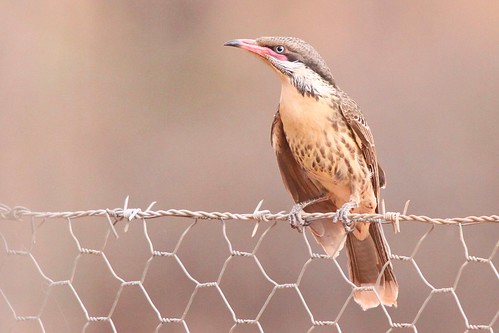
Spiny-cheeked Honeyeater (pictured above)
White-plumed Honeyeater
Budgerigar
White-breasted Woodswallow
Black-faced Woodswallow
Galah
Red-tailed Black Cockatoo
Corella
Zebra Finch
Magpie Lark
White-bellied Cuckoo-Shrike
Willie Wagtail
Australian raven
Crested Pigeon
Diamond Dove
Australian Magpie
White-winged Fairywren
Eyrean Grasswren
Brown Falcon
Grey Fantail