Saturday, February 16, 2013
Lake Glenbawn: Ski Beach
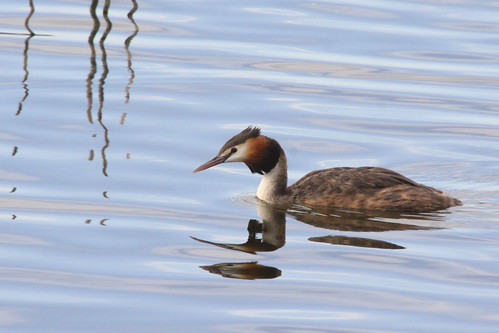
There were Great Crested Grebes visible near the shore around most of the lake, but in a sheltered corner near Ski Beach four pairs were nesting in the submerged shrubs close to the bank.
Three pairs of birds had already laid eggs, with one bird sitting on the nest and the other floating nearby, adding to the nest, chasing away coots or just keeping an eye of things. A fourth pair had just started nest building at some distance from the others.
Next day their nest had been destroyed and they were building another, still some way from the established pairs but in the other direction. They were attempting to take sticks from the other nests so there was quite a bit of agitated chasing.
Next time I visited one of the eight birds was missing. I watched for around two hours while the eggs lay exposed in the nest an one bird circled in the water nearby. It did sit on the eggs for a few minutes at a time, but spent most of the time beside it.
Then after a couple of hours an eighth bird turned up. There was a brief "courtship"exchange and one of them climbed onto the nest and the other took up watch. Order had been restored.
I'm planning a return visit. I'd love better photos of grebes carrying babies on their backs that I have managed in the past.
Sunday, January 29, 2012
Sunday, February 21, 2010
Walka Waterworks
Friday, December 11, 2009
Walka Waterworks
Out and about early, I headed out to Walka Waterworks in the hope of catching some waterbirds with their reflections. The recent reports of a Black Honeyeater in the grevilleas along the track provided an added incentive.
In Newcastle the day had begun clear and still, but clouds began to gather as I reached Maitland, and after less than an hour ambling along the track I'd lost most of the light and the wind had started to pick up, so a day's outing became a two hour walk.
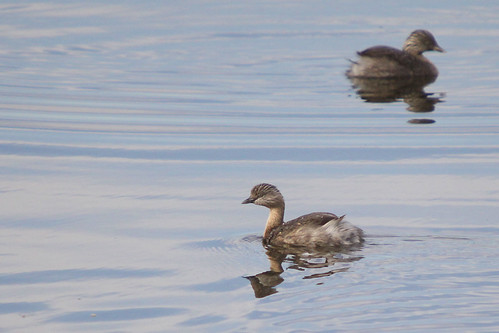
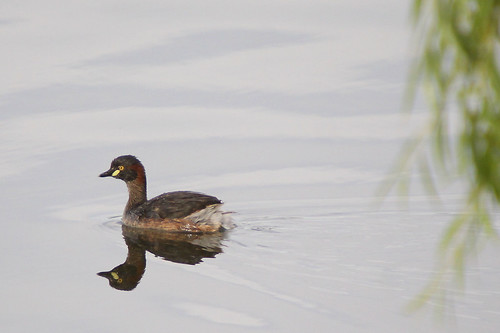
Yellow-faced honeyeaters were everywhere, dollar birds were giving their distinctive calls from the top of a eucalypt, over twenty hardheads floated out in the middle of the pond, and reed-warblers played hide and seek at the water edge. Grebes were there in good numbers.
Bird list:
Pacific Black Duck
Australian Shoveler
Chestnut Teal
Hardhead
Australasian Grebe
Hoary-headed Grebe
Great Crested Grebe
Little Black Cormorant
Great Cormorant
Little Pied Cormorant
White-faced Heron
Royal Spoonbill
Purple Swamphen
Eurasian Coot
Masked Lapwing
Rainbow Lorikeet
Eastern Rosella
Laughing Kookaburra
Dollarbird
Yellow-faced Honeyeater
Noisy Miner
Red Wattlebird
Australian Raven
Welcome Swallow
Australian Reed Warbler
Willie Wagtail
Grey Fantail
Silvereye
Superb Fairywren
Yellow-rumped Thornbill
Yellow Thornbill
Rufous Whistler
Australian Figbird
Magpie Lark
White-winged Chough
Australian Magpie
Common Miner
Monday, August 10, 2009
Walka Reserve
Step 2 Both holding the weed face each other, rising out of the water as they tread with their feet..
The Great Crested Grebe has a long and elaborate courtship, with displays so complex they are often referred to as dances. Both sexes perform a series of displays, many of which are forms of normal behaviour that have been exaggerated and have become almost rituals.
In the headshaking display, the two prospective partners face each other with their necks straight and their head feathers spread out. They then turn their heads rapidly from side to side. The display usually ends with ritual preening.
The discovery dance involves one of the birds fluffing out its feathers and spreading it wings, while the other dives and rises erect from the water with its bill pointing downwards.
Another, the retreat display, has one bird suddenly dashing away across the water and then turning to face its mate.
By far the most complex is the weed dance in which both birds, like synchronized swimmers, dive together then rear up from the water and face each other, breast to breast, with their beaks full of weed as they dance and display to each other. The images above show the weed dance. This mutual display may be in the form of a "promise" to build a nest, as it is material from the lake bottom that comprises much of the material.