Showing posts with label Alcedinidae. Show all posts

Wednesday, May 15, 2013

Winton to Clermont

Red-backed Kingfisher
From Winton I headed east along the Capricorn Highway through towns where I spent my childhood. In Aramac, where my grandparents lived I came across this Kingfisher outside the little tramways museum. In Barcaldine I camped at the Showground where every evening the trees filled with Cockatoos, Corellas and Lorikeets.

Little Corella

Rainbow Lorikeet
I camped outside Clermont at the Theresa Creek Dam, built since I moved south to provide water for the Blackwater and Blair Athol mines. Whistling Kites soared and called, Pale-headed Rosellas and Rainbow Lorikeet came down to drink, and good numbers of Egrets, Ducks, Coots, Native Hens, Morehens and Swamphens edged the water. Comb-crested Jacana walked on the water lillies, and Apostlebirds and Grey-crowned Babbler fussed around in the shrubs.

Comb-crested Jacana
Grey-crowned Babbler

Apostlebirds
Blue-faced Honeyeater

Sunday, January 29, 2012

Pioneer Dairy Swamp

052_1
103_1
132_1
142_1
162_1
The Tuggerah Lakes Reserve is more commonly known as the Pioneer Dairy Swamp. It is predominantly cleared land that for a long time has been used for dairying. The Reserve has been the subject of much debate and negotiations amongst the past owners and their attempts to sell the site for development, community groups who have fought to save the site from development, and numerous Government departments who have been involved throughout the process, which lasted over several years.
The Electricity Commission acquired the property in 1986 as part of its plans to build a power station at Mardi. In 1989, the old manager’s house was leased to people who ran cattle on the site. The Mardi power station never eventuated, and the EC attempted to auction the site in1996, but the property was withdrawn 30 minutes before it was due to go to auction purportedly due to expressed environmental concerns regarding the sale. The property was again placed on the market in June 1999, however public protest resulted in a new committee being formed that lobbied the State Government for its preservation. The property’s sale was once again temporarily withdrawn pending a Supreme Court decision on an Aboriginal claim. Although this claim was rejected, pressure from the community and conservation groups stalled the sale for almost 12 months as they continued to lobby the State Government.
In 2000, the Reserve was finally gazetted as Crown land for environmental protection and public recreation, and is presently under the care of the Tuggerah Lakes Reserve Trust. It will be open to the public from the middle of 2012.

Murrays Beach

021_1023_1025_1026_1052_1

Even Laughing Kookaburras get involved in family arguments during the holiday season.

Thursday, October 29, 2009

Talbert Nature Preserve

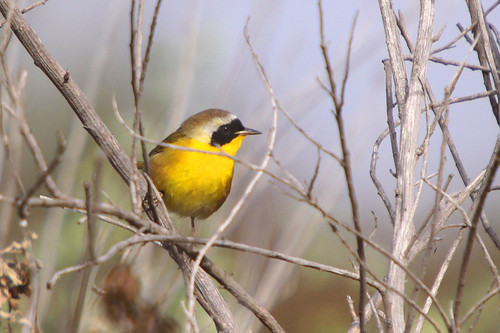
Common Yellowthroat

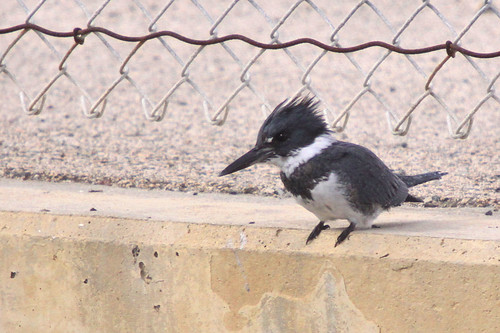
Belted Kingfisher

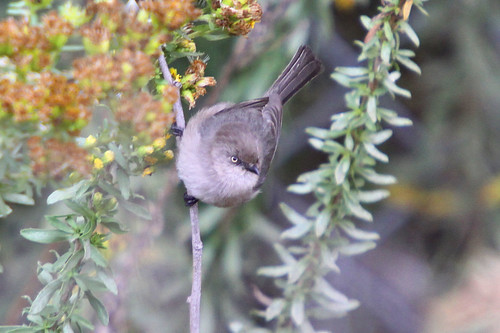
Bushtit


Talbert Nature Preserve is just a few minutes away from Newport Beach in Costa Mesa, and as I had a few hours free on my last day in California I headed here for a walk. Though I had set my trusty GPS, I had a momentary problem finding it. I parked in the small parking area, but the 'preserve' seemed to be just a paved bike track alongside a large fenced storm-water drain. I was there, however, so I set off along the bike track.

A short way along the canal, I took a gravel path designated for walkers which soon became the nature preserve I was looking for. There were six different habitats (i.e. wetlands, sand dunes, woodlands), which were signposted with basic information about the vegetation, wildlife and ecological importance. The paths were primarily roped off from the surrounding area, so while at times I could hear lots of birds, it was difficult to photograph them.

I was thrilled, however to get photos of three birds that I have been seeing regularly without any opportunity of grabbing a pic. Not great photos, but certainly good record shots.

The kingfisher flies around Newport Bay regularly, I see it perched on boats out in the harbour. But it had so far always been too distant, or noticed too late. There have been large groups of busy bushtits at a number of places, but they have stayed deep in the shrubs and scattered when I came too close - I wasn't even sure of their ID previously. The yellowthroat has been a rapidly moving patch of gold in the shrubs at a number of spots around Orange County, but my only images of him had him pretty well obscured by branches.


With the Santa Ana River on one side and the Costa Mesa Bluffs on the other, the Talbert Preserve provided good views of a number of raptors. A small pond held ducks, egrets and a heron.

Wednesday, August 5, 2009

Mount Vincent

One the way back from the Regent Honeyeater Survey we stopped briefly at Mount Vincent where there seemed to be lots of honeyeaters, so I went back today for a longer walk.
There certainly were a good number of birds high in the flowering stringybarks. Bell miners were bathing in the dam, and a wedge-tailed eagle soared high overhead. A kookaburra was being mobbed by the honeyeaters and miners. The Brown Falcon was having trouble staying on his wire and soon flew off to a distant pole. These birds are also known as the Cackling Falcon, after their distinctive call.


Bird List:

Brown Falcon (pictured above)
Laughing Kookaburra (pictured above)
Bell Miner (pictured above)
Little Lorikeet
Australian King-Parrot
Sacred Kingfisher
Superb Fairywren
Variegated Fairywren
Bell Miner
Lewin's Honeyeater
Yellow faced Honeyeater
Fuscous Honeyeater
White naped Honeyeater
White cheeked Honeyeater
Eastern Spinebill
Eastern Yellow Robin
Grey Fantail
Willie Wagtail
Pied Currawong
Red-browed Finch
Welcome Swallow

Friday, July 10, 2009

Palmerston


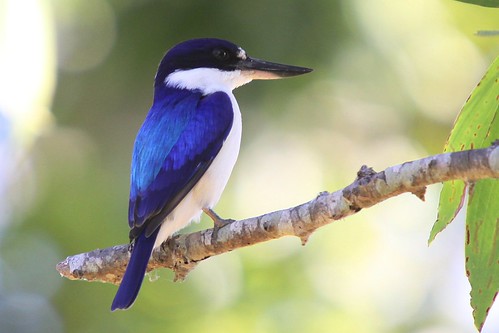
Today's walk took us to the Palmerston area, Elizabeth River, Channel Island and Marlow Lagoon Reserve. We took the track from the boat ramp parking area at Elizabeth River and were passed by a first response team and a police vehicle - they didn't advise us of axe murderers or chemical spills, so we continued along. The mangroves seemed to be full of red-headed honeyeaters, hard to photograph as they buzzed around, but great to see. When we reached the electricity pylons at the river's edge, two more were perched on the barbed wire.

Channel Island was an interesting spot. Large numbers of terns fished and perched on buoys far out in the water. The lemon-bellied flycatcher sang in the car-park. Red-winged parrots flew overhead. It was a very high tide so there were no shore birds, but it would be worth a re-visit at low tide.

Marlow Lagoon was a wonderful choice for a picnic spot. A very pretty park filled with birds. Lots of bee-eaters, a good number of egrets, geese, ducks, ibis, lapwings ... and honeyeaters, trillers, magpie larks and kingfishers. A grey goshawk circled above. We sat on a bench by the water and watched the bee-eaters buzzing the water while we ate our sandwiches. It was cool, for Darwin, and a beautiful restful spot.

Bird List:

Forest Kingfisher Todiramphus macleayii (pictured above)
Magpie Goose Anseranas semipalmata
Green Pygmy-Goose Nettapus pulchellus
Darter Anhinga melanogaster
Pied Cormorant Phalacrocorax varius
Great Egret Ardea alba
Intermediate Egret Ardea intermedia
Straw-necked Ibis Threskiornis spinicollis
Australian White Ibis Threskiornis molucca
Brahminy Kite Haliastur indus
Grey Goshawk Accipiter novaehollandiae
Whistling Kite Haliastur sphenurus
Gull-billed Tern Sterna nilotica
Crested Tern Sterna bergii
Sulphur-crested Cockatoo Cacatua galerita
Red-winged Parrot Aprosmictus erythropterus
Rainbow Bee-eater Merops ornatus
White-gaped Honeyeater Lichenostomus unicolor
Brown Honeyeater Lichmera indistincta
Red-headed Honeyeater Myzomela erythrocephala
Lemon-bellied Flycatcher Microeca flavigaster
Magpie Lark Grallina cyanoleuca
Varied Triller Lalage leucomela
Black-faced Cuckoo-Shrike Coracina novaehollandiae
Torresian Crow Corvus orru

Tuesday, July 7, 2009

South Alligator River


As tourists we did the obligatory jumping crocodile cruise, and while it was interesting to see the crocs up close and amazing to see how fast and far they can move when tempted by the promise of food, the highlight of the cruise was the kites and sea-eagle that flew so close they were almost impossible to capture - though I used a good part of a card trying. I was thrilled with some of the images I managed with my ancient reflexes.


On to Aroura Kakadu where we set up camp, then wandered over to the beer garden where a large flock of corellas made it hard to think and impossible to talk. Refreshed and fed, we took the torches out for a walk watching a colony of Black Flying Foxes going about their business. An owl flew over which may have been a barn owl, barking owls barked, and unseen things skittered around in the undergrowth. I'm not very good at spotlight walks.


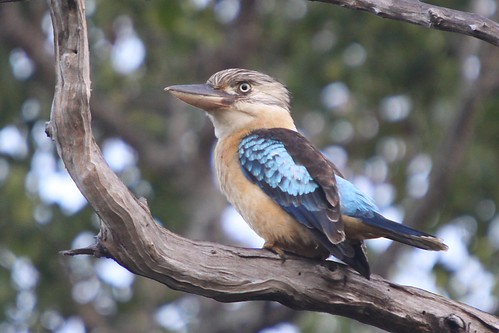
Next morning, early, we did the Gungarre Walk which starts and ends at the resort. Around 3k in length, it passes through monsoonal vine forest, across a floodplain beside a billabong and through fringing woodland in a loop. The combination provided a good range of birds, and some excellent photo opportunities. The bee-eaters at the billabong were fascinating, flying low over thewater and returning to their perch - a loud clack indicating a catch. Kookaburras sounded as though they were trying to laugh, but couldn't quite get it. Dozens of fig birds and orioles were feeding in the trees. The billabong was covered with water lillies and water birds. Tiny terns cruised the far bank, staying out of camera range.

A bench seat at the edge of the water looked inviting, despite the crocodile warning signs.

Bird list:

Blue-winged Kookaburra Dacelo leachii (pictured above)
Orange-footed Scrubfowl Megapodius reinwardt
Plumed Whistling-Duck Dendrocygna eytoni
Green Pygmy-Goose Nettapus pulchellus
Magpie Goose Anseranas semipalmata
Straw-necked Ibis Threskiornis spinicollis
Australian White Ibis Threskiornis molucca
Black-necked Stork Ehippioryhnchus asiaticus
Royal Spoonbill Platalea regia
Black Kite Milvus migrans
Whistling Kite Haliastur sphenurus
Peaceful Dove Geopelia striata
Bar-shouldered Dove Geopelia humeralis
Pied Imperial-Pigeon Ducula bicolour
Little Corella Cacatua sanguinea
Sulphur-crested Cockatoo Cacatua galerita
Red-collared Lorikeet Trichoglossus haematodus
Red-winged Parrot Aprosmictus erythropterus
Oriental Cuckoo Cuculus saturatus
Rainbow Bee-eater Merops ornatus
Rainbow Pitta Pitta iris
White-throated Honeyeater Melithreptus albogularis
Lemon-bellied Flycatcher Microeca flavigaster
Australasian Figbird Sphecotheres viridis
Yellow Oriole Oriolus flavocinctus