Showing posts with label Rhipiduridae. Show all posts

Sunday, August 8, 2010

HiFert

We were out walking about an hour before sunrise today, the air was crisp but it promised a beautiful day. Silvereyes were abundant, most with the rusty flanks of the Tasmanian race – they should soon be headed back south. Red-browed finches, yellow thornbills, golden-headed cisticolas, superb fairywrens and brown-honeyeaters were all in their usual spots, singing up the sun.

A highlight was a juvenile black-shouldered kite calling from a low fence as two adults hunted the grassland. The breeding season is usually August to January, so these two got an early start. Within a week of leaving the nest the young birds are capable of hunting for mice on their own, and disperse fairly widely from the nest site, so this nest would have been close by. Their nest is generally located in the canopy of an exposed tree in open country, and there are a few large trees standing high above the surrounding mangroves and grasslands here that would suit.

Following the unwritten avian law on dealing with bird photographers, they had moved out of range by the time the light was good enough for a photo. So I filled a card trying to capture a willie wagtail hawking insects on the grass.

074_1

083_1

Tuesday, September 8, 2009

Dalhousie Springs


Our lunchtime stop on the way to Purni Bore was Dalhousie Springs, an oasis in the centre of Witjira National Park. Comprising a group of about 80 mound springs, with one of the larger springs minimally developed as a swimming hole, it is a great spot to experience the reputed health benefits of the warm mineral waters. While the middle of the day was too hot to really appreciate a warm swim, the area was a gathering place for both bush and waterbirds.

Though the red sand dunes were seemingly endless the national park also contains salt lakes, tracts of spinifex and gidgee woodland and, wherever moisture collected, stunning and unexpected bursts of colourful wildflowers. At the springs, natural and planted native trees and shrubs along with the date palms gave an oasis feel, and clean modern facilities provided a touch of luxury. This was a popular camping spot, with many people visiting the springs who were not continuing to cross the Simpson.

Bird list:

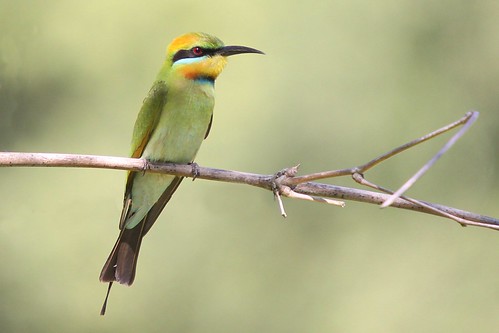
Rainbow Bee-eater (Pictured above)
Australian Grebe
Variegated Fairywren
Grey Fantail (Pictured above)
Welcome Swallow
Hardhead
Zebra Finch

Friday, July 31, 2009

Kooragang Island


After his surgery I have to keep Thommo away from playmates, water and sand so I'm back at the wasteland on Kooragang Island. All the familiar little birds were there, and terns and gulls on the river. A young sea eagle flew over directly overhead carrying something that was trailing ribbons - hard to tell just what from the photos.
I snapped a few photos of him, but concentrated on 'action' shots of the wagtails. I got a few nice images of fanned tails, but I like this shot of its characteristic scolding pose.
The willie wagtail is one of Australia’s most common birds, but one of our most charming. It is in almost constant motion feeding or defending its territory. During feeding it will give sudden flicks of its wings to startle insects which it then catches with a fast agile flight, similarly it will startle insects on the ground into flight. I remember as a kid being told that their song was them saying ‘sweet-pretty-creature’ but they have a range of calls including a loud metallic chatter when annoyed. Then tend to scold the dogs, and will even fly down onto their backs, pecking at them. They are quite aggressive and will attack predators far larger than themselves that come near their nests.
Interestingly, it can expand its white eyebrow to show its emotions, so the eyebrow can change from being almost invisible to being quite conspicuous.