Showing posts with label Falconidae. Show all posts

Saturday, May 26, 2012

Soldiers Point

274_1

The Australian (or Nankeen) Kestrel is Australia's smallest falcon and probably the one most people are familiar with. It is often seen on roadside power lines or hovering above sports fields looking for mammals, insects and reptiles.  Once they have their prey in sight, they plunge head first toward the ground, pulling out of their dive at the last moment to strike with their feet.

Kestrels have specially adapted eyes which enable them to see ultra violet light.  This ability allows them to see scent and urine trails which are invisible to humans, and gives them the advantage when hunting to know where to expect to find their prey.

253_1

214_1

This bird was hovering off the side of the bluff at Soldiers Point. Fishermen had driven away all the shorebirds so I was headed home when I saw him from the carpark. Great to get shots from this point of view, rather than my usual belly shots.

Sunday, May 30, 2010

Kooragang Island

126_1

142_1

168_1

When I need a little bird photography expedition to clear my head, but can’t take more than half an hour I tend to head for the Kestrel street on Kooragang Island. They didn’t disappoint this afternoon, with one of the pair sitting on the fence wire as I drove up, then flying down to catch a grasshopper over the roadway, and taking it back to a perch on a concrete post. The 50D played fair with focus actually locking on in Al Servo mode, so my images were even sharp. Very pleased with the outcome, I was almost content to go back to grading student papers.

Wednesday, February 24, 2010

Hunter River

156_1

Australian Kestrel Falco cenchroides

The name kestrel is given to several members of the falcon genus, distinguished by their typical hunting behaviour which is to hover over open country and swoop down on prey, usually small mammals, lizards or large insects. Other falcons are more adapted to active hunting on the wing.

Australian Kestrels are often seen hovering over road reserves and paddocks.  Once they have their prey in sight, they plunge head first toward the ground, pulling out of their dive at the last moment to strike with their feet.

This female has a regular territory along the river from Kooragang Dykes to Walsh Point.

Wednesday, September 9, 2009

Bowra Station

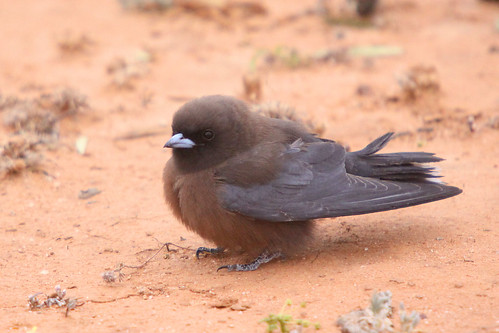
Little Woodswallow
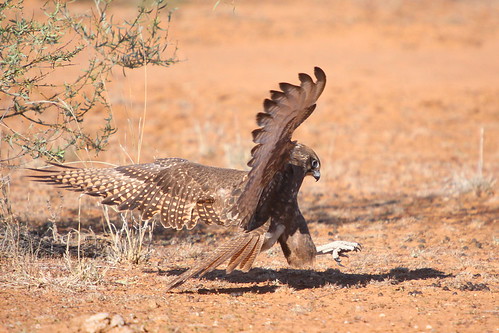
Brown Falcon
Bowra Station is justifiably known as one of Australia's 'birding hotspots'. Formally privately owned by a couple who encouraged birdwatchers, it is in the process of being purchased by the Australian Wildlife Conservancy using a combination of government grants and private donations. Not all of the Conservancy's properties are regularly open to visitors so birders are anxiously waiting to see what the policies will be at Bowra.

The afternoon we arrived was heavily overcast, making conditions difficult for bird photography. We settled down beside the homestead lagoon to watch large flocks of ibis test out various trees for suitability as a night time roost. They eventually decided against this spot, and all flew off into the dusk. We had some light rain over night, but the next day dawned clear.

Around the homestead and its lagoon were ibis, stilt, ducks, heron, dotterel, swallows, flycatchers, woodswallows, babblers, tree creepers, parrots and an active bowerbird bower. No sign of the Grey Falcon which reportedly visits the home lagoon, but it had not been seen for some weeks - since the young fledged.

We went out to Sawpits Waterhole spotting Bourke's Parrots just where the sign said they would be under the mulga, and watching a Spotted Bowerbird take a lengthy bath. Ringnecks were involved in a noisy courtship routine, and the whistlers' loud, melodious song was heard along the banks. Honeyeaters defended choice clumps of eucalypt blossoms.

Near the Main Creek crossing we pursued Halls and Grey-crowned Babblers, waiting for them to sit still long enough to have their portrait taken. The Button Quail didn't hang about either. The dozens of woodswallows searching for insects on the eucalypts were more obliging. A juvenile even came and sat near us on the ground, presenting several angles to ensure a flattering image.

At Stony Lookout we saw two Chestnut-breasted Quail Thrush, and in following them came across a Red-backed Kingfisher and male and female Red-capped Robins, and Slaty-backed Thornbills. We could hear the Crested Bellbird but could not locate it.

Back at the homestead to pack up camp, Chestnut-crowned Babblers searched for insects at the edge of the lagoon, and a Restless Flycatcher hovered over the water.

Bird List:

Emu
Grey Teal
Hardhead
Australian Wood Duck
Pacific Black Duck
Australian Pelican
Little Black Cormorant
Australasian Darter
White-necked Heron
Great Egret
Straw-necked Ibis
Yellow-billed Spoonbill
Royal Spoonbill
Whistling Kite
Wedge-tailed Eagle
Black-shouldered Kite
Black Kite
Nankeen Kestrel
Brown Falcon
Australian Hobby
Little Button-quail
Black-tailed Native-hen
Common Bronzewing
Diamond Dove
Crested Pigeon
Peaceful Dove
Little Corella
Galah
Major Mitchell's Cockatoo
Mallee Ringneck
Blue Bonnet
Red-winged Parrot
Red-rumped Parrot
Bourke's Parrot
Mulga Parrot
Budgerigar
Laughing Kookaburra
Red-backed Kingfisher
Sacred Kingfisher
Brown Honeyeater
White-plumed Honeyeater
Little Friarbird
Yellow-throated Miner
Singing Honeyeater
Noisy Friarbird
Spiny-cheeked Honeyeater
Striped Honeyeater
Black-faced Cuckoo-shrike
Grey Shrike-thrush
White-winged Triller
Australian Raven
Welcome Swallow
Tree Martin
Fairy Martin
Willie Wagtail
Jacky Winter
Red-capped Robin
Crested Bellbird
Rufous Whistler
Grey-crowned Babbler
Hall's Babbler
Chestnut-crowned Babbler
White-winged Fairy-wren
Splendid Fairy-wren
Inland Thornbill
Slaty-backed Thornbill
Southern Whiteface
White-browed Treecreeper
Brown Treecreeper
Magpie-lark
White-winged Chough
Apostlebird
White-breasted Woodswallow
White-browed Woodswallow
Masked Woodswallow
Black-faced Woodswallow
Little Woodswallow
Grey Butcherbird
Pied Butcherbird
Australian Magpie
Spotted Bowerbird
Australasian Pipit
Zebra Finch

Monday, September 7, 2009

Eringa Waterhole


Australian Hobby - Race murchisonianus, originally uploaded by alwynsimple.

We arrived in Oodnadatta to find that the guy who ran the tyre service at the Pink Roadhouse was away for the weekend, he'd be back Monday - or maybe Tuesday. So we did a quick trip to Coober Pedy; a few beers in an underground bar, a night in a caravan park, early morning repairs by a very obliging garage and back to Oodnadatta. At least it gave us the opportunity to see the Moon Plain (where films like Mad Max, Priscilla and Pitch Black were filmed) and Coober Pedy though we no longer had time for the Painted Desert.

Back to Oodnadatta then across Fogarty's Claypan without incident as it was conveniently somewhere in between too wet and too dry. Ponds along the road dug to support roadworks attracted clouds of zebra finch and flocks of diamond doves.

We had been following a bicycle track for some time, and caught up with the rider at Eringa Waterhole. It would have been interesting to find out his story - bicycling through the Simpson is hardly a mainstream activity, but he wasn't inclined to chat.

The explorer John McDouall Stuart camped at Eringa during his trips in the 1860’s, but long before this it was a significant area in Aboriginal mythology. The waterhole was part of the holdings of the ‘cattle king’, Sir Sidney Kidman, and the ruins of a house, a rainwater tank and a meathouse built during the Kidman era were interesting to explore. With the permanent water and majestic white-trunked gum trees, it was a very pretty spot.

Bird list:

Australian Hobby - Race Murchisonianus (pictured above by Alwyn Simple)
Western Shrike -Thrush
Australian Raven
Cockatiel
Yellow-throated Miner
White-plumed Honeyeater
Wedge-tailed Eagle
Black Kite
Galah
Diamond Dove
Zebra Finch
Australian Magpie
White-breasted Woodswallow
Black-fronted Dotterel
Australian Grebe
Magpie Lark
Pied Butcherbird
Willie Wagtail
Whistling Kite
Black-Faced Cuckoo-Shrike

Wednesday, August 5, 2009

Mount Vincent

One the way back from the Regent Honeyeater Survey we stopped briefly at Mount Vincent where there seemed to be lots of honeyeaters, so I went back today for a longer walk.

There certainly were a good number of birds high in the flowering stringybarks. Bell miners were bathing in the dam, and a wedge-tailed eagle soared high overhead. A kookaburra was being mobbed by the honeyeaters and miners. The Brown Falcon was having trouble staying on his wire and soon flew off to a distant pole. These birds are also known as the Cackling Falcon, after their distinctive call.


Bird List:

Brown Falcon (pictured above)
Laughing Kookaburra (pictured above)
Bell Miner (pictured above)
Little Lorikeet
Australian King-Parrot
Sacred Kingfisher
Superb Fairywren
Variegated Fairywren
Bell Miner
Lewin's Honeyeater
Yellow faced Honeyeater
Fuscous Honeyeater
White naped Honeyeater
White cheeked Honeyeater
Eastern Spinebill
Eastern Yellow Robin
Grey Fantail
Willie Wagtail
Pied Currawong
Red-browed Finch
Welcome Swallow

Tuesday, August 4, 2009

Stockton Channel

Yellow-rumped Thornbill


Australian Hobby

We were up particularly early this morning - probably as a result of falling asleep in front of the television. So I walked the dogs in the dark, and grabbed the camera from the car just as the sun rose.

A large group of thornbills were chirping in the mangroves and I was attempting to capture them in the very poor light when a hobby flew onto a sunlit perch beside me. He could have positioned himself a little better, but he perched there for some time much to the consternation of the thornbills, which immediately became still and quiet.

The hobby is one of Australia's smallest raptors. They will hunt small birds, up to nearly their own size. The yellow-rumped thornbill is one of the more common thornbills, identifiable by its spotted head as well as its yellow rump.

I stopped in at Stockton Sandspit, and came across the Hunter Bird Observers Club, gathering for their Tuesday walk. I chatted for a moment, but we had been out for two hours and a hot breakast was marginally more appealing than more walking.

Bird list:

Australian Hobby (pictured above)
Yellow-rumped Thornbill (pictured above)
Black Swan
Little Black Cormorant
Australian Pelican
White faced Heron
Great Egret
Australian White Ibis
Superb Fairy wren
Little Wattlebird
Black-faced Cuckoo-shrike
Magpie Lark
Willy Wagtail
Feral Pigeon
Brown Honeyeater
Spur-winged Plover

Saturday, August 1, 2009

Stockton Channel

Australian Kestrel

Swamp Harrier


We generally park just after the bridge and walk along the mangroves before crossing to the beach.


It was afternoon and the mangroves were backlit, but as the tide was coming in it meant walking out through the squishy mud to get on the sunny side of the thornbills, brown honeyeaters and gerygones I abandoned any thought of photos of the mangrove inhabitants.


Luckily there were some raptors out - though the sea eagles stayed well in the distance over the river. There are twenty four diurnal raptor species native to Australia. The Swamp Harrier (Circus approximans) belongs to the Family Accipitridae, and the Australian Kestrel (Falco cenchroides) to the Family Falconidae.


Australian Kestrels are sometimes called Nankeen Kestrels after the red-brown cloth 'nankeen'. When hunting they plunge head first toward the ground, pulling out of their dive at the last moment to strike with their feet. Kestrels have specially adapted eyes which enable them to see ultra violet light, giving them the ability to see scent and urine trails which are invisible to humans, and gives them the advantage when hunting to know where to expect to find their prey. Adult male kestrels are identifiable by their grey heads and tails, while adult females have a brown head and rufous tail. The female birds are generally larger than the males.


The Swamp Harrier is largely dark brown, becoming lighter with age, and has a distinct white rump. Females are larger with rufous underparts, while the smaller male is lighter underneath. It hunts by flying slowly, low to the ground, on upswept wings. When hunting they 'quarter', which means that they systematically search for prey covering the ground thoroughly. The swamp harrier is widespread throughout Australia, and is usually found in wetlands and well-watered open country.