Showing posts with label Columbidae. Show all posts

Monday, May 13, 2013

Winton

Crested Pigeon
We checked into the Matilda Country Tourist Park, where we were given a great spot under a group of trees, and set up our 'big camp', a screened gazebo under which we could have a little tent for sleeping, Dusty's crate, a kitchen table, and a chair and coffee table. It was HOT, and flies were BAD, so we were the envy of those who had to choose between the caravan and the open.

Birding was good from the gazebo with Yellow-throated Miners, White-plumed Honeyeaters, and Inland Thornbills foraging in and under the trees, and a dripping tap attracting a steady stream of birds.

Apostlebird
Of an evening birds gathered on the powerlines to bath in pools left behind by the sprinkler.

Black-faced Woodswallow

Diamond Dove

White-plumed Honeyeater

Zebra Finch

Galah

White-breasted Woodswallow

Wednesday, July 21, 2010

Hi Fert

051_1

Bar-shouldered Dove

030_1

White-browed Scrub Wren

Back on our home turf at HiFert on Kooragang Island, the dogs happily followed scent trails on the grass while the scrub wrens scolded from the bitou bush. The resident group of bar-shouldered doves had found spilled grain by the side of the road, and a group of around thirty red-browed firetails satisfied themselves with grass seeds.

The male superb-fairy wrens were resplendent in their breeding plumage. Willie-wagtails and grey fantails were hawking for insects, and yellow thornbills and silvereyes hid in the casuarinas. Brown honeyeaters and a single red wattlebird called from the banksias.

A young white-bellied sea eagle cruised overhead, little inconvenienced by the screeches of the masked-lapwing. White and straw-necked ibis pecked over the boggy areas.

Over the river were great crested terns, silver gulls and Australian pelicans while little pied and little black cormorants floated on the surface.

Wednesday, February 10, 2010

Blackbutt Reserve

20100210_107_1 20100210_164_1

We came across a number of birds sunning themselves. A rail was standing with its back to the sun with its feathers rustled up to expose the skin below, noisy miners were in a full sunbathing posture with wings and tail feathers spread out to maximize the area open to the sun. The bronzewing pigeons were lying on one side with one wing raised to the sun. The reasons for sunning, and benefits to the bird are a matter of supposition. Obviously, in many cases the birds get warmth from the sun which reduces the amount of metabolic energy they have to expend in order to maintain a constant body temperature of around 40 degrees C.

However, it's summer here. Some birds do sunbathe in temperatures which are quite hot, and they end up over-heated as they can be seen panting. Therefore, some scientists have theorised that the sun's warmth is important in helping dislodge feather parasites. Others suggest that the ultra-violet in sunlight helps turn some precursor molecule in the preening oil into vitamin D and that the birds need this vitamin. It is known that these precursor molecules exist in preening oil and that ultra-violet light will stimulate the conversion into vitamin D. What is not known is how well this happens on the bird's body and how important the amount of vitamin D created would be to the bird.

Tuesday, September 8, 2009

Mt Dare

Black-faced Woodswallows (by Alwyn)

Budgerigars (by Alwyn)


Crested Pigeons (by Alwyn)


We met up with the others at Mt Dare, to start the Simpson Crossing. A steak dinner, a catch up with the various travel experiences of the others and cultivating the friendship of Chester, the hotel dog, occupied the evening. We gained agreement to a late-ish start so that we could do some birding at the dam and bore overflow at first light. Our efforts were well rewarded.

Huge flocks of budgerigars, galahs, zebra finches, corellas and red-tailed black cockatoos perched on every available tree waiting a turn at the water. White-breasted and black-faced woodswallows circled and returned to favourite branches. Honeyeaters fed on the garden shrubs. My laptop died before I had copied more than 4 of 14 folders to an external hard drive, I was able to recover the files from the card in the 30D with the wide angle, but not from the 50D which I was using for bird photography. So most of my birds from the trip are gone. I've posted some from Alwyn here to give an idea of the feast and famine situation with birds in the desert. Find water and you'll find birds.

Heading to Dalhousie Springs, we stopped at Blood's Creek and then at 3 O'Clock Creek. At Blood's Creek we saw yet another flock of Zebra Finches - these are tough little birds, able to eke out a living in the most arid landscapes. Blood's Creek was an important waypoint for both the Overland Telegraph and the Ghan Railway. In 1901 the Government put down a 2002 ft bore and a giant windmill which still spins slowly today, though there is little water available on the surface. Legend has it that when a traveller died here, they only had enough whiskey crates to make a short coffin with an open end and had to bury the man with his legs sticking out of the end of the box.

We stopped at 3 O'Clock Creek for a closer look at the Red Mulga or Minniritchi (Acacia cyperophylla). Also in the area were Coolibah, mentioned in Waltzing Matilda, Witchety Bush, amongst whose roots the tasty grubs can be found and Dead Finish, a wattle with such survival skills that it is said that when it dies everything is over.

Fairywrens and grasswrens flittered amongst the spindly shrubs.

Bird List:

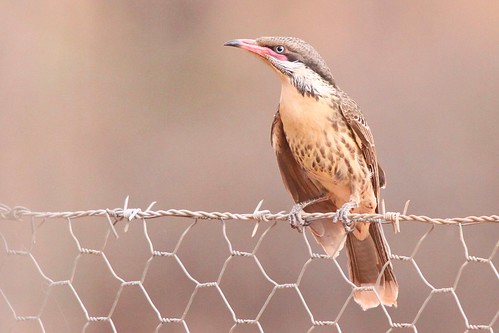
Spiny-cheeked Honeyeater (pictured above)
White-plumed Honeyeater
Budgerigar
White-breasted Woodswallow
Black-faced Woodswallow
Galah
Red-tailed Black Cockatoo
Corella
Zebra Finch
Magpie Lark
White-bellied Cuckoo-Shrike
Willie Wagtail
Australian raven
Crested Pigeon
Diamond Dove
Australian Magpie
White-winged Fairywren
Eyrean Grasswren
Brown Falcon
Grey Fantail

Saturday, June 20, 2009

Coconut Grove


I had some end of semester admin to tidy up, so no walk today. I set myself up on the patio with the laptop and my camera beside me.

The little rufous-banded honeyeaters are here regularly, attracted to the blossoms on the palm trees. They come down to drink at the bird bath, perching first on a branch set up for the purpose and nervously looking from side to side. They will have a quick drink and fly back to the perch to look around, then return for another sip. They bath in a fly-through action, and seem to prefer the deeper bird bath for this.


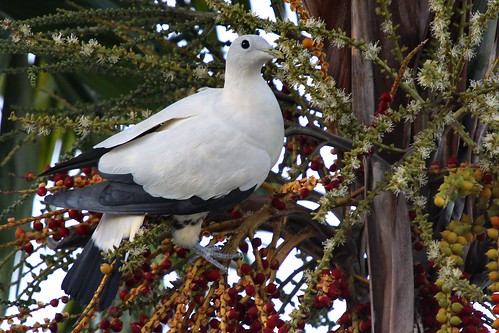
The highlight of the day was a pair of Pied-Imperial Pigeons who came to eat the palm fruits. They swallow the quite large fruits whole and digest the pulp before excreting the seeds.


Bird List:

Pied Imperial-Pigeon Ducula bicolour (pictured above)
White-gaped Honeyeater Lichenostomus unicolor
Brown Honeyeater Lichmera indistincta
Rufous-banded Honeyeater Conopophila albogularis
Australian Figbird Sphecotheres veilotti