Showing posts with label Petroicidae. Show all posts

Wednesday, April 3, 2013

Pillaga Scrub


The Pilliga Scrub is the common name of The State Forests of The Pilliga,an area of 3000 km² of semi-arid woodland in temperate north-central New South Wales, The forest contains at least 900 plant species,although the dominate species appears to be the cypress-pine (Callitris spp.), with areas of casuarina and eucalypts.

Baradine is the administrative centre of the Pilliga Scrub and its major access point. The road from Coonabarabran through Baradine to Pilliga features large in Australian mythology, with truckers and other travelers reporting bizarre and terrifying encounters along the road. Reports include min-min lights, a ghost (the Pilliga Princess), electrical anomalies and disturbances, unidentifiable noises, Yowie sightings, and even physical attacks by seen and unseen creatures. The best examined account was the story told by a caller to the late-night talk-radio program Overnights, which had dedicated a discussion to experiences in the Pilliga. The caller, who identified himself only as Bongo, recounted an experience in the scrub in 1978 which ended with a lengthy stay in a sanitarium, the Happy Days Retreat. 


While Bongo's story has its share of detractors and skeptics, I myself had an alarming experience on the road which left me with shattered nerves and a new found caution in travelling the backroads. A cattle truck came around a corner towards me well over the speed limit, and well and truly on my side of the strip of tar. Taking to the shoulder I hit a pot hole and destroyed two rims and tyres, 30k from Coonabarabran with no signal. Luckily the gentleman who lives at the Duke of Wellington, Bugaldie (an old Cobb & Co Inn), was headed back home for lunch in a break from ploughing - he took me and my wheels into town, where we located a set of Impreza wheels that had been traded on a set of mags, saving me a three day wait and the expense of new rims. I then set off with the confidence boost of three spare tyres.

I stayed at Camp Cypress at the Baradine showground, and armed myself with the wealth of information from the Pilliga Forest Discovery Centre to do a series of morning drives out into the scrub - Yarrie Lake, The Aloes, the Salt Caves, Dandry Gorge, Odells Crossing, Western Way.


The female Red-capped Robin did not seem impressed by the males' displays.
At Wittinbra Dam on the Odells Well Road I came across a group of Red-capped Robins. They are territorial during the breeding season, but would be expected to be dispersing at this time of year to pair up and defend their home range in August. Three males were singing from exposed perches, then flying to a perch close to one of the others to be met with scolding and wing waving.  The sole female stayed within the scrub, and seemed completely disinterested in the boys' games. It is possible that it was a family group, the young males soon to leave the home territory.

The Red-capped Robin is one of many declining woodland species in Australia, the victim of habitat reduction. While once common on the Cumberland Plain in Western Sydney, it is now  rare east of the Great Dividing Range. Interestingly, it is one of the first birds to return to an area after a bushfire. It eats beetles, ants and spiders; pouncing on its prey on the ground and returning to a low branch.

The family tree of the  Red-capped Robin (Petroica goodenovii and its Australian relatives is under debate; the Petroicidae are not closely related to either the European or American robins but appear to be an early offshoot of the songbird infraorder Passerida. It was originally classified in the Old World flycatcher family Muscicapidae, but was later moved to the genus Petroica. Within the genus, it is one of five red- or pink-breasted species of robin colloquially known as "Red Robins".


Bird List:


  • Emu
  • Brown Quail
  • Magpie Goose
  • Black Swan
  • Australian Wood Duck
  • Pacific Black Duck 
  • Darter
  • Little Pied Cormorant
  • Little Black Cormorant
  • White-necked Heron
  • White-faced Heron
  • Straw-necked Ibis
  • Royal Spoonbill
  • Black-shouldered Kite
  • Wedge-tailed Eagle
  • Nankeen Kestrel
  • Common Bronzewing
  • Crested Pigeon
  • Peaceful Dove
  • Bar-shouldered Dove
  • Glossy Black Cockatoo
  • Galah
  • Sulphur-crested Cockatoo
  • Australian King Parrot
  • Red-winged Parrot
  • Eastern Rosella
  • Blue Bonnet
  • Red-rumped Parrot
  • White-throated Treecreeper
  • Brown Treecreeper
  • Spotted Pardalote
  • Inland Thornbill
  • Buff-rumped Thornbill
  • Yellow thornbill
  • Noisy Miner
  • White-plumed Honeyeater
  • Jacky Winter
  • Red-capped Robin
  • Eastern Yellow Robin
  • Grey-crowned Babbler
  • Rufous Whistler
  • Grey-shrike Thrush
  • Magpie Lark
  • Grey Fantail
  • Willie Wagtail
  • Black-faced Cuckoo-Shrike
  • White-breated Woodswallow
  • Dusky Woodswallow
  • Grey Butcherbird
  • Pied Butcherbird
  • Australian Magpie
  • Pied Currawong
  • Australian Raven
  • White-winged Chough
  • Apostlebird
  • Australian Pipit
  • House Sparrow
  • Welcome Swallow
  • Rufous Songlark
  • Common Starling


Thursday, December 22, 2011

Big Lagoon, Bruny Island

3/12/2011

IMG_0353_1

IMG_0355_1

Pulling into a parking area just before the airstrip, we walked down to the Big Lagoon, the first part of a track to Cape Queen Elizabeth. Grey Shrike Thrush were calling and dislodging insects from bark crevices, Grey Fantail were everywhere, lots of Yellow-rumped Thornbill, Yellow-tailed Black Cockatoos flying overhead, and a Brush Bronzewing flushed from the edge of the track. Striated Pardalotes were high in the trees. A Flame Robin foraging and returning to a fence perch gave us regular, if distant photo opportunities. The high mesh fence was some metres behind a standard barbed-wire fence and inside the enclosure were half a dozen Emu – Emu are farmed in Tasmania.

Back at the carpark we met a group from the local Birdwatchers Club, they confirmed that the itinerary we’d drawn up was going to give us the best chance for good birding, and as the rain came down we shared the spot to find the Flame Robin.

Saturday, April 10, 2010

Black Spring TSR

On Easter Saturday, a walk through the Black Spring TSR was hot and dusty. It is a remnant of the once vast Grassy White Box Woodland that covered the area, and runs alongside the road about 6.5k south of Barraba. Maureen and I trudged the 3k to the end without coming across water in any of the three waterholes. Heading up to the top of the ridge we were snapping Mistletoe birds when a  Speckled Warbler came down to scold us. It followed us as we worked our way uphill.

IMG_8461_1Mistletoebird - female

IMG_8425_1

Speckled Warbler

A number of tiny birds were chasing insects in the top of the eucalypts. Buff-Rumped and Yellow-Rumped Thornbills, White-Throated Gerygone and Weebills.

IMG_8526_1Weebill

Australia’s smallest bird, Weebills are a bit of a challenge for photographers, as they move fast high in the trees. I managed to get my best shots yet of the little cutie. On the way back to camp we stopped to watch several Jack Winter catching insects on a large mistletoe clump.

IMG_8304_1Jacky Winter

Thursday, April 8, 2010

Borah Creek

Kookaburras woke us bright and early next morning but were soon followed by a dawn chorus that had me vowing to make a determined effort to learn more bird calls. I recognised the distinctive Crested Shrike-Tit, and the Grey Shrike-Thrush, Rufous Whistler and Pied Currawong. Lots of thornbills and fairywrens, and three King Parrots flew into the top of a nearby dead tree. We had tea and breakfast bars, and waited for the sun to rise.

Headed out on a walk around the reserve there were Brown Treecreepers on every trunk, and a pair of Hooded Robin where we were told to expect them. Little Lorikeet usually stay high up in the canopy, but a group perched on a dead tree in the early morning light.

IMG_7337_1 A pair of Rufous Whistlers were trying to ignore the begging of their almost full-grown young. The young birds seemed to have no fear of photographers, or perhaps they were trying all possible sources of a fee meal.

IMG_7355_1

IMG_7714_1 White-Throated Gerygone and Fuscous Honeyeaters, White-plumed Honeyeaters and a young Brown Songlark were hunting for insects. Ann directed us to a tree in which both Diamond Firetails and Striated Pardalotes were feeding young, and we sat on a log and watched for some time, taking way too many photos given that the size of the birds and their distance from the ground limited any chance of a ‘crippling’ image.

A Wedge-Tailed Eagle flew high overhead, carrying a large branch. For early autumn there were a large number of birds nesting or raising young.  Dusky Wood-swallows were hawking over a patch of open grass, and White-backed Swallows circled above. Back at camp a Grey Shrike-Thrush had found a spider, and an Eastern Yellow Robin looked on.

IMG_8137_1

IMG_8170_1

Tarpoly Creek TSR

IMG_7241_1

After being seriously let down by the printed directions, abandoned by my GPS and led astray by Alwyn, I eventually linked up with him, and with Maureen, and located the turnoff. I drove slowly through Tarpoly Creek TSR, looking for promised Plum-headed Finches in vain. Paragliders lurching out of the scrub with immense packs kept stopping me to ask where they were. Tiny, mainly yellow, birds kept to the top of the trees and only this Hooded Robin and a Jacky Winter paused to offer a photo opportunity.

Thursday, July 30, 2009

Blackbutt Reserve


Blackbutt Reserve has a number of distinct areas and the Richley Reserve - entrance via Freyberg Street, New Lambton - is usuallybetter for getting away from the school groups and picnickers that tend to stay around the caged birds and animals at the main entrance.


I only had an hour so I hung by the ponds training my lens on the ducks, however there were lots of bush birds in the nearby trees. The whistlers, in particular, were very vocal, with some splendid golden males offering some excellent photo opportunities.


Bird list:


Eastern Yellow Robin (pictured above)
Sulphur Crested Cockatoo
Galah
Little Corella
Crimson Rosella
Eastern Rosella
Rainbow Lorikeet
Superb Blue Fairy Wren
Eastern Whip Bird
Willy Wagtail
White Faced Heron
Australian Grey Teal
Chestnut Teal
Pacific Black Duck
Hardhead Duck
Black Swan
Straw necked Ibis
White Ibis
Black Faced Cuckoo-Shrike
Welcome Swallow
Laughing Kookaburra
Little Black Cormorant
Pied Cormorant
Australasian Grebe
Dusky Moorhen
Eurasian Coot
Grey Butcher Bird
Grey Fantail
Spotted Turtle Dove
Australian Raven
Magpie
Magpie Lark
Striated Pardalote
Silvereye
Noisy Miner
Rufous Whistler
Golden Whistler
Yellow Thornbill

Wednesday, June 17, 2009

East Point Reserve


I parked near the mangrove boardwalk and stepped out of the car to have a brown falcon fly out of the tree at my head, and a rainbow pitta rush past my feet. Promising start, though no photo opps. The walk to the boardwalk is quite short, but a birders paradise.

A clump of bamboo provided a hiding spot for several types of finches, including the scarlet. A dingo moved off the path to let me pass - just a bike ride from the city-centre. Fantails and flycatchers flittered in the shrubs. Flowering mangroves had attracted so many friarbirds that I could hardly hear myself think, and the smaller honeyeaters, including the beautiful red-headed, had retreated to an area near the shore. Kingfishers waited on strategic branches.

A walk around the lake brought more honeyeaters, this time on the blossoms of the palm trees, dozens of fig birds, and a pair of nesting long-tailed finches. Also lakeside were herons, egrets and ibis, and a beach stone-curlew.

Bird List:


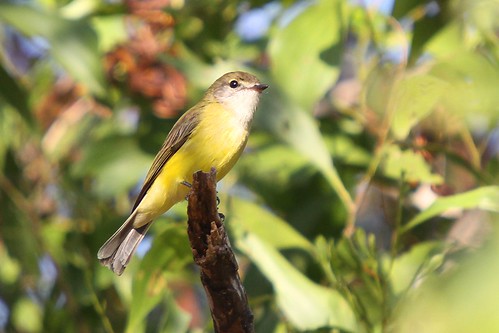
Lemon-bellied Flycatcher Microeca flavigaster (pictured above)
Red-headed Honeyeater Myzomela erythrocephala
Orange-footed Scrubfowl Megapodius reinwardt
Pied Cormorant Phalacrocorax varius
Great-billed Heron Ardea sumatrana
White-faced Heron Egretta novaehollandiae
White-necked Heron Ardea pacifica
Eastern Reef-Egret Egretta sacra
Straw-necked Ibis Threskiornis spinicollis
Australian White Ibis Threskiornis molucca
Black Kite Milvus migrans
Brahminy Kite Haliastur indus
Whistling Kite Haliastur sphenurus
Brown Falcon Falco berigora
Beach Stone-Curlew Esacus neglectus
Masked Lapwing Vanellus miles
Feral Pigeon Columba livia
Bar-shouldered Dove Geopelia humeralis
Forest Kingfisher Todiramphus macleayii
Sacred Kingfisher Todiramphus sanctus
Rainbow Bee-eater Merops ornatus
Rainbow Pitta Pitta iris
Red-browed Pardalote Pardalotus rubricatus
Little Friarbird Philemon citreogularis
Helmeted Friarbird Philemon buceroides
Blue-faced Honeyeater Entomyzon cyanotis
White-throated Honeyeater Melithreptus albogularis
Rufous-banded Honeyeater Conopophila albogularis
Brown Honeyeater Lichmera indistincta
Northern Fantail Rhipidura rufiventris
Magpie Lark Grallina cyanoleuca
Spangled Drongo Dicrurus bracteatus
Australian Figbird Sphecotheres vieilloti
White-breasted Woodswallow Artamus leucorhynchus
Double-barred Finch Taeniopygia bichenovii
Long-tailed Finch Poephila acuticauda
Crimson Finch Neochmia phaeton