Showing posts with label Rallidae. Show all posts

Wednesday, July 24, 2013

Leeton

Spotted Crake
Leeton is actually a top spot, I discovered on my first visit. Walking/cycling tracks run for miles, there are great little coffee shops and restaurants, excellent state parks and wonderful landscapes and two Ramsar listed wetlands of international importance. Best visited in the warmer months when thousands of migratory birds call the area home, even in the middle of winter there was plenty to see (although this winter was unusual as there was still quite a lot of water after last years floods, the wetlands can be dry at this time).

The facilities at  Fivebough and Tuckerbill Swamps suffered quite a bit of damage during the floods but the walking tracks, hides, and seating have been rebuilt. It was woolly hat cold when I was there but the walks were pleasant in the morning sun.


Bird list:
Brown Quail
Black Swan
Australian Wood Duck
Grey Teal
Chestnut Teal
Pacific Black Duck            
Australasian Grebe
Rock Dove
Common Bronzewing
Crested Pigeon
Peaceful Dove
Australasian Darter
Little Pied Cormorant
Little Black Cormorant
Pied Cormorant
Australian Pelican
White-necked Heron
Eastern Great Egret
White-faced Heron
Little Egret
Australian White Ibis
Straw-necked Ibis
Royal Spoonbill
Yellow-billed Spoonbill
Black-shouldered Kite
Whistling Kite
Swamp Harrier
Little Eagle
Nankeen Kestrel
Brown Falcon
Purple Swamphen
Australian Spotted Crake
Black-tailed Native-hen
Dusky Moorhen
Eurasian Coot
Black-winged Stilt
Red-necked Avocet
Red-capped Plover
Black-fronted Dotterel
Red-kneed Dotterel
Masked Lapwing
Caspian Tern
Silver Gull
Laughing Kookaburra
Superb Fairy-wren
Variegated Fairy-wren
Yellow Thombill
Yellow-rumped Thombill
Striated Pardalote
Blue-faced Honeyeater
Noisy Friarbird
Rufous Whistler
Grey Butcherbird
Pied Butcherbird
Australian Magpie
Pied Currawong
Grey Fantail
Willie Wagtail
Australian Raven
Magpie-lark
Silvereye
Common Starling
Zebra Finch


Wednesday, January 12, 2011

Shortland, Newcastle

097_1

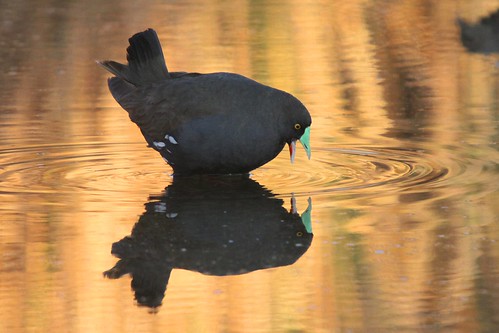
Dusky Moorhen

344_1

Magpie Geese

438_2

Buff-banded Rail

683_1

White-breasted Woodswallow

730_1

Freckled Duck

829_1

Australian Ibis

941_1

Australian Darter

Lots of babies and young birds at the Hunter Wetlands Centre yesterday. Good to spend a day outdoors – we did have to wait out a few showers in the hides but it was ‘fine’ for the most part.

Horrific stories of the floods in Queensland on the news. The impact on people and their property is devastating, but many of our native animals will also be impacted. Many species will have found higher ground but ground-dwelling fauna such as reptiles and small mammals, particularly those living in burrows along the rivers may not have survived. The effects will be long term: vast tracts of riparian vegetation have been submerged or swept away, floodplains will be covered with silt, trees have been dislodged and fallen timber swept downstream.  However for the birds and animals that survive the flooding, the water does bring with it a number of positive effects. Conditions can be better than before with water channels flushed and opened up, seeds dispersed, and habitats opened up.

In 1974 we were living and working in Brisbane, in flood affected areas of Milton, St Lucia and Indooroopilly, so my thoughts are very much with the people who are dealing with the 2011 floods.

Tuesday, January 5, 2010

Blackbutt Reserve

20100105_426_1

Buff-banded Rail

Blackbutt Reserve is 182 hectares of ridge spurs and sheltered gullies, just ten minutes from downtown Newcastle. While most visitors stay close to the Black Duck picnic area, there are kilometres of trails through a variety of habitats. Near the picnic area are a series of enclosures where visitors can get close-up views of a number of bird and animal species.

Today, after ten days of rain, quite a few of the birds were sunning themselves with spread wings - this rail offering a great view of his beautifully patterned feathers.

Map picture

Tuesday, September 8, 2009

Purni Bore

Grey Teal at sunrise (by Alwyn)


Spotted Crake (by Alwyn)


Black-tailed Native Hen

By the time we reached Purni Bore, it was hot, there were thousands of bush flies in my ears, up my nose and filling the space between my eyes and my sun glasses. (I have a number of photos that feature extreme close-ups of the flies). Alwyn went birding and was rewarded with great photos of an Australian (Spotted) Crake and a Spotless Crake. I sat in the shade of the tank-stand where a juvenile western gerygone came obligingly close, pecking on the ground under an acacia, and trillers stayed out of camera range in the shrubs.

The bodies of two camels lay together just off the road. Unfortunately the only camels we saw on the trip were dead or captive.

Overnight I heard a noise outside and looked out of the tent to see a dingo 2 metres away. He had found something to eat in the ashes of a previous camper's fire, and stood there for some minutes finishing his snack.

The morning dawned cool and clear. Just on first light my dingo howled nearby, and was answered by another in the dunes - their conversation continued for some moments. Wonderful! A light mist hovered over the billabong and the early morning light reflected off the reed beds turned its surface to liquid gold. A large group of native hens went about their business, galahs and corellas filled the trees and ducks floated motionless in imitation of pool ornaments.

Purni Bore is the result of drilling by the French Petroleum Company in 1963. It was capped and sealed when they abandoned oil exploration, but over time the wellhead corroded and water flowed out of the bore at a rate of up to 18 litres per second, creating an artificial wetland. The bore was capped in 1987 when the excessive flow was found to be affecting the flow of the nearby Dalhousie Springs. Travellers used to be able to swim at Purni Bore, but since the water flow was reduced reeds have grown along the bore drain. Now a sufficient flow is maintained to sustain the wildlife that has come to rely on this permanent water source. We saw footprints of dingoes, kangaroos, wallabies and camels, and many lizards and small mamals.

Water flows out of the borehead at 85C. Almost hot enough to make tea!

Bird List:

Black-tailed Native Hen
Australian Crake
Grey Teal
White-headed Stilt
Black-fronted Dotterel
Spotless Crake
White-winged Triller
White-winged Fairywren
Western Gerygone
Galah
Little Corella