Sunday, September 6, 2009
Edward's Creek
The Edward's Creek Siding was an important maintenance point on the Old Ghan, and was then re-developed during the second world war as a crew change station. Today it is an interesting collection of ruins .. however on stopping, we noticed a bore with associated trees and shrubs on the other side of the road, so we turned left.
The creek was dry, though the extensive coolabah trees along the banks were evidence that it is sometimes filled with water (cooliah seeds must be immersed in water to germinate). Water was pumped from a bore into a holding tank and a stock trough, the overflow from the tank creating a tiny wetland.
As is the case everywhere in the desert where water is provided, the birds were in abundance. There were several Port Lincoln ringnecks with their blue-black heads feeding and roosting in the trees. White-plumed honeyeaters came down to drink at the overflow. A large flock of zebra finches perched in the salt bush, and took turns to come to the edge of the pool. A red-backed kingfisher perched watching the wetland. We ate lunch quickly - not wanting to miss a photo opportunity, and reluctant to provide the hordes of bush flies with additional sustenance.
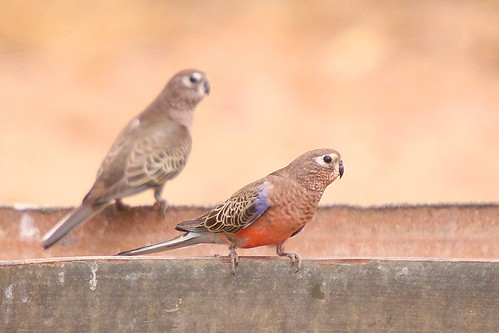
Then one of those moments that happens all too rarely in a bird photographer's life. A pair of Bourke's Parrots flew down to the water trough less than ten metres from us, and stayed there for three or four minutes.
Bird List:
Bourke's Parrot (Pictured above)
Peaceful Dove
White-plumed Honeyeater
Zebra Finch
Galah
Yellow-throated Miner
Little Corella
Port Lincoln Ringneck
Red-backed Kingfisher
William Creek
The Memorial Park contains an eclectic collection of objects such as the first stage of the Black Arrow Rocket, Britain's only successful independent space launch, and a truck belonging to the outback mailman Tom Kruse, who was the subject of a 1950s documentary called Back of Beyond.
While the town had the usual collection of 'urban' birds, about 10 kms before we reached town two quail-thrush crossed the road ahead of us and scampered up onto the old ghan line. Hard to believe they were finding something to eat in the arid stony region we were travelling through.
Bird List:
Cinnamon Quail-thrush
Magpie-lark
Black Kite
Galah
Friday, September 4, 2009
Coward Springs
Coward Springs is a veritable oasis in the desert. During the construction of the Ghan Railway Coward Springs became a large settlement and even after its completion, when the railway workers had moved on further north, Coward Springs remained an important siding for a long time.
A natural spa has been built over the springs, providing a soothing dip for weary travellers before feeding a wetland area of over 200 hectares that has been fenced to exclude stock. Over 120 bird species have been recorded here, with new birds sighted each year. The old buildings have been wonderfully restored with marvellous touches of bush craft and railway memorabilia. Even lighting the 'donkey' fire for hot water was a mini outback adventure.
It was dark when we pulled up, and soon began to rain, but the morning dawned fine, if cloudy. We were on a tight schedule to meet up with others at the appointed time, but we packed up, and went for a walk around the wetlands. The path we chose, unfortunately, led down a side of the bore drain that was heavily vegetated and it was difficult to good photo opportunities where the water birds were concerned. Bush birds were a little easier to capture.
At the Beresford ruins, a little further on, a dam gave us an opportunity for further birding with ducks and grebes on the water and honeyeaters in the shrubs.
Bird list
Galah
Australian Raven
Spotless Crake
Australian Spotted Crake
Pied Honeyeater
Rainbow Bee-eater
Chirruping Wedgebill
Little Corella
Australian Grebe
Hardhead
Red-necked Avocet
Black-winged Stilt
White-plumed Honeyeater
White-breasted Woodswallow
Crested Pigeon
Black Kite
Australian Magpie
Magpie Lark
Zebra Finch
Singing Honeyeater
Southern Whiteface
White-breasted Cuckoo-Shrike
Willie Wagtail
Welcome Swallow
Wabma Kadarbu
Due to their isolation from other water courses over millions of years, they have developed unique ecology and a spring can support flora and fauna found nowhere else in the world.
Blanche Cup and The Bubbler are active mound springs in the conservation park. Hamilton Hill, a large hill in an otherwise flat landscape, is an extinct mound spring. The Bubbler had a very strong flow of water, and lush greenery alongside its stream. Blanche Cup supported a small wetland.
We pulled in just on sunset. The water was so clear that you could see it bubbling up at the bottom of the pool. The combination of the crusty limestone deposits, the clear running water, and the lush vegetation gave the landscape an 'other world' appearance, especially in the soft light of dusk.
Bird List:
Red-necked Avocet (pictured above)
Black-fronted Dotterel
Willie Wagtail
Zebra Finch
Thursday, September 3, 2009
Old Ghan Railway Heritage Trail
We were following the Old Ghan Railway Line that was abandoned when it was replaced with the current Ghan Line, which runs further west. Named after the afghan traders that rode their camels through these parts, the railway follows the old telegraph line, the construction of which was the impetus for Burke and Wills’ fateful journey.
We stopped at Farina for lunch. The area was originally proclaimed a town in 1878 and called “Government Gums” because of the mature River Red Gums in the creek to the north of the town. Later it’s name was changed to “Farina” (Latin for wheat or flour) by farmers who optimistically hoped to turn the vast flat lands here into fields of grain. For a few years the rains were unusually good, and copper and silver were found in the area. At its peak the town had a bakery, grain store, two breweries, two hotels, a general store, post office, Anglican church, five blacksmiths and a school. However the silver ran out, and years of drought ended the farmer's dreams. Today it is a picturesque ghost town, with resident kestrels, and bits and pieces of rusting farming and mining equipment. Sad to think of the shattered dreams lying in the dust - but this was a scenario that we would see repeated throughout the outback.
Pole Creek also marked the boundary of Finniss Springs Aboriginal land. The Lake Eyre Basin has supported a long history of Aboriginal settlement and use, and Finnis Springs is the traditional homeland of the Arabunna people. We stopped at Plane Henge fascinated by the planes buried in the ground like totem poles or post-modern crufixes. The other artworks were also wonderful - my favourite an old Ghan water-tank now transformed into a giant cattle dog, guarding the landscape.
We pulled over at the lookout over Lake Eyre South. The lake was dry, but the impression of vast empty space was powerful. The size of the area, and its remoteness, gave a physical presence to the mythology of Australianness.
The Curdimurka Siding was another interesting stop. Originally home to the fettlers who looked after the stretch of track between Marree and William Creek, the building has had some basic restoration and the rooms are available as a sheltered camp for travellers. To raise funds for the preservation of the various Ghan sidings the Ghan Railway Preservation Society holds a bi-annual ball at the Curdimurka siding. The first ball, in 1986 was attended by a few hundred people, mainly from Adelaide and from the stations and towns in the vicinity. In recent years the ball has become a popular 4WD event for clubs, individuals and tour groups and attracts over 3000 guests from all over Australia and even some from overseas. It's held in even numbered years in October. Swallows occupied every wire, and galahs queued to drink from the handleless frypan catching the drips from a tap in the yard.
Bird list:
Wednesday, September 2, 2009
Flinders National Park
Apostlebirds fussed around us as we set up our tents in the relative luxury of the Resort campgrounds - hot showers, flush toilets, powerpoints and internet access. A father emu wandered past with a large brood of stripey chicks. (BTW that's 'eem you' not 'ee moo'). We had arrived around mid-afternoon so had time for a walk before sunset.
Wilpena Pound is a natural amphitheatre formed by two mountain ranges to the east and west joined by Rawnsley's Bluff in the south. The wall of mountains creates a gently-sloping bowl which is the Pound, with the only breaks being the gorge at Wilpena Gap and a high saddle in the south-western range over which the Heysen Trail passes.
During 1926 Hans Heysen visited the Flinders Ranges and was particularly impressed with its great variety of majestic gum trees. He said in a letter "The great Red Gums in the creek beds fill me with wonder; their feeling of strength of limb, of vigour and life, suggest the very spirit of endurance." His watercolour, Guardian of Brachina Gorge beautifully evokes the area.
Harold Cazneaux took a photograph one of these giant red gums, with the walls of Wilpena Pound as background, in May 1937. He regarded it as his most Australian picture and called it the Spirit of Endurance. He wrote: "This giant gum tree stands in solitary grandeur on a lonely plateau in the arid Flinders Ranges, South Australia, where it has grown up from a sapling through the years, and long before the shade from its giant limbs ever gave shelter from heat to white men. The passing of the years has left it scarred and marked by the elements - storm, fire, water, - unconquered, it speaks to us from a Spirit of Endurance. Although aged, its widespread limbs speak of a vitality that will carry on for many more years. One day, when the sun shone hot and strong, I stood before this giant in silent wonder and admiration. The hot wind stirred its leafy boughs, and some of the living elements of this tree passed to me in understanding and friendliness expressing The Spirit of Australia." The tree still stands and is simply known as 'the Cazneaux tree'.
Bird list:
Emu (pictured above)
Apostlebird
Australian Raven
Black-faced Cuckoo-Shrike
Little Corella
Galah
Australian Wood Duck
Australian Magpie
Red-capped Robin
Black Kite
Square-tailed Kite
White-plumed Honeyeater
Australian Kestrel
Wedge-tailed Eagle