Friday, July 31, 2009

Kooragang Island


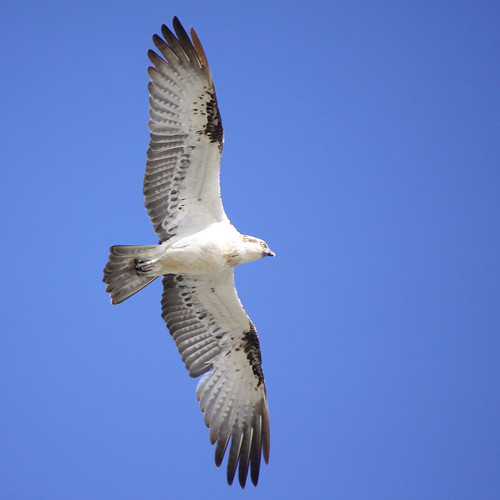
After his surgery I have to keep Thommo away from playmates, water and sand so I'm back at the wasteland on Kooragang Island. All the familiar little birds were there, and terns and gulls on the river. A young sea eagle flew over directly overhead carrying something that was trailing ribbons - hard to tell just what from the photos.
I snapped a few photos of him, but concentrated on 'action' shots of the wagtails. I got a few nice images of fanned tails, but I like this shot of its characteristic scolding pose.
The willie wagtail is one of Australia’s most common birds, but one of our most charming. It is in almost constant motion feeding or defending its territory. During feeding it will give sudden flicks of its wings to startle insects which it then catches with a fast agile flight, similarly it will startle insects on the ground into flight. I remember as a kid being told that their song was them saying ‘sweet-pretty-creature’ but they have a range of calls including a loud metallic chatter when annoyed. Then tend to scold the dogs, and will even fly down onto their backs, pecking at them. They are quite aggressive and will attack predators far larger than themselves that come near their nests.
Interestingly, it can expand its white eyebrow to show its emotions, so the eyebrow can change from being almost invisible to being quite conspicuous.

Thursday, July 30, 2009

Blackbutt Reserve


Blackbutt Reserve has a number of distinct areas and the Richley Reserve - entrance via Freyberg Street, New Lambton - is usuallybetter for getting away from the school groups and picnickers that tend to stay around the caged birds and animals at the main entrance.


I only had an hour so I hung by the ponds training my lens on the ducks, however there were lots of bush birds in the nearby trees. The whistlers, in particular, were very vocal, with some splendid golden males offering some excellent photo opportunities.


Bird list:


Eastern Yellow Robin (pictured above)
Sulphur Crested Cockatoo
Galah
Little Corella
Crimson Rosella
Eastern Rosella
Rainbow Lorikeet
Superb Blue Fairy Wren
Eastern Whip Bird
Willy Wagtail
White Faced Heron
Australian Grey Teal
Chestnut Teal
Pacific Black Duck
Hardhead Duck
Black Swan
Straw necked Ibis
White Ibis
Black Faced Cuckoo-Shrike
Welcome Swallow
Laughing Kookaburra
Little Black Cormorant
Pied Cormorant
Australasian Grebe
Dusky Moorhen
Eurasian Coot
Grey Butcher Bird
Grey Fantail
Spotted Turtle Dove
Australian Raven
Magpie
Magpie Lark
Striated Pardalote
Silvereye
Noisy Miner
Rufous Whistler
Golden Whistler
Yellow Thornbill

Wednesday, July 29, 2009

Hunter Estuary National Park


Stockton Sandspit has a new sign. The Hunter Estuary National Park includes the sandspit, Hexham Swamp, the Wetlands Centre and part of Ash Island.
Today a large number of Tasmanian Silvereyes (Zosterops lateralis lateralis) were enjoying the banksia in the early morning light.

Tuesday, July 28, 2009

Bird Journal


Version 1.3 of Bluebird Technologies Bird Journal includes Christidis and Boles taxonomy, making it now more relevant to Australian Birders. It won't replace that Spirex notebook, but will add a whole new dimension to birding records.

Francis Street


I live in a rather leafy suburb, and my bit of it has especially large, old trees so sometimes I can do my birding from the couch. Today I was treated to a group of Sulphur Crested Cockatoos who were systematically removing the branches from a flowering tree. Occasionally they gave the flowers a nibble, but for the most part they seemed to be just biting off branches and dropping them on the ground.

Sunday, July 26, 2009

Goolawah State Park

Variegated Fairywren - male in breeding plumage


Variegated Fairywren - male, non-breeding

If this blog had more than its three readers, I would not mention Goolawah here, as one of its major attractions is that so few people seem to know about it. New South Wales eleventh, and newest, state park, it encompasses significant coastal lands, stunning beaches, wetlands, littoral rainforest and swamp sclerophyll forest. It is proposed that the Park will eventually include a beach walking track along the spectacular coastline from Port Macquarie to Crescent Head. But for the moment there is little in the way of human interference to the natural landscape. Camping is primitive, with cold outdoor showers and composting toilets the nearest thing to an 'amenity'.

Dogs are allowed off-leash on the beach, and on-leash in the camping areas and on the bush tracks so it is a perfect spot for a short getaway around three hours north of newcastle.

Among the animals identified within Goolawah State Park are swamp wallabies, kangaroos, bandicoots, echidnas, possums, dingos, sugar gliders and many species of bats. Birdlife includes shorebirds and raptors along the beach, waders and waterfowl in the wetlands, and many species of honeyeaters, seedeaters and insectivorous birds living in the forests.

We were only going to stay a couple of days, but the weather was perfect, we found nesting Osprey, and usually had the beach entirely to ourselves, so we ended up being there for the working week.

Bird List:

Variegated Fairywren (pictured above)
Black Swan
Australian Wood Duck
Pied Cormorant
Little Black Cormorant
Australian Pelican
White faced Heron
Great Egret
Cattle Egret
Australian White Ibis
Straw necked Ibis
Osprey
Black shouldered Kite
Whistling Kite
Brahminy Kite
White bellied Sea Eagle
Nankeen Kestrel
Purple Swamphen
Silver Gull
Gull billed Tern
Crested Tern
White fronted Tern
Rock Dove
Brown Cuckoo Dove
Crested Pigeon
Yellow tailed Black Cockatoo
Galah
Rainbow Lorikeet
Scaly breasted Lorikeet
Laughing Kookaburra
Superb Fairywren
Variegated Fairywren
White browed Scrubwren
Yellow rumped Thornbill
Yellow Thornbill
Striated Thornbill
Red Wattlebird
Little Wattlebird
Noisy Miner
Magpie-lark
Grey Fantail
Willie Wagtail
Spangled Drongo
Black faced Cuckoo shrike
Figbird
Grey Butcherbird
Pied Butcherbird
Australian Magpie
Pied Currawong
Australian Raven
Australian Pipit
Welcome Swallow

Crescent Head


A pair of Osprey are raising two chicks in a nest on top of a Norfolk Island Pine in the Crescent Head Caravan Park, on the New South Wales mid-north coast.
Osprey nests are built up each year, sometimes for decades, from sticks, seaweed, branches and driftwood, and can weigh up to half a ton. The female incubates the eggs for around 35 days, depending on the male to feed her. Both birds then feed the young. The chicks take their first flight around 55 days after hatching.
Its specific habitat requirements have contributed to its decline in NSW, where it is officially listed as vulnerable.

Threats:

  • Removal of large trees near the coast that could be used as nest sites.
  • Disturbances to water quality that increases turbidity in feeding areas.
  • Ingestion of fish containing discarded fishing tackle.
The locals were very proud of their Osprey, with many people pointing out the nest to me. Most though, thought it was a small Sea Eagle that couldn't fish properly - diving into the water, rather than snatching fish on the surface.