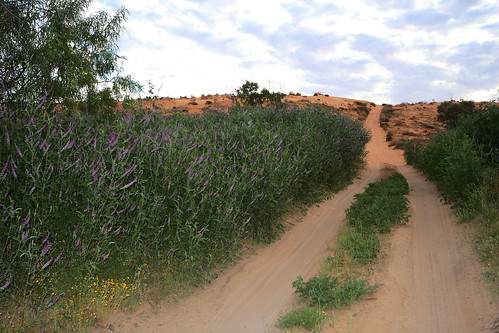
(Sesbania cannabina) and an unidentified purple flowering plant formed tunnel walls either side of the track. Coolibah trees (Eucalyptus coolabah), belalie (Acacia stenophylla) and lignum (Muehlenbeckia florulenta) shrubs dotted the area. Deep ruts crossing the swale testified to recent muddy conditions.
Wednesday, September 9, 2009
Flood Plain
(Sesbania cannabina) and an unidentified purple flowering plant formed tunnel walls either side of the track. Coolibah trees (Eucalyptus coolabah), belalie (Acacia stenophylla) and lignum (Muehlenbeckia florulenta) shrubs dotted the area. Deep ruts crossing the swale testified to recent muddy conditions.
Tuesday, September 8, 2009
Simpson Crossing

From Purni Bore we travel the French Line. The challenges primarily came from the corrugations on the dunes - the result of people who don't let their tyres down to low enough pressure, and who then put their foot down heavily in several attempts to get over the dunes, carving out the subsand and then continuing on their way oblivious of the damage they have done. Our drivers seemed to be working on a footprint length of 300 to 350 mm which translated to 18 psi on the Prados and 16 psi on the Pajero.
At the Bore we met two KTM riders with a support team who were aiming for a three day crossing, but for most vehicles four or even five days is more realistic. 100 km a day leaves time for appreciating the view, photographs, and rest and meal stops.
The French Line from Purni Bore to Colson Junction crosses the Simpson Desert Regional Reserve with sand dunes averaging 8 to 12 metres in height. Just before Colson Junction we struck our first tricky dune - about 20 metres high with a dog-leg across the top, soft sand, deep holes beside cane grass mounds and a scalloped approach.
The Colson Track heads south, running along a swale between the lines of dunes, to meet the WAA Line. Clay topped for the most part, the track was smoothish compared to the French line and a change from crossing the dunes.
We turned east on the WAA line which seemed little travelled compared to the French line. It's interesting how quickly wind and the occasional rain shower can return the track to pristine desert. The dunes were higher than those we'd encountered on the first part of the French Line, perhaps averaging 12 to 20 metres. Many of them had a sharp drop on the eastern side. We encountered a couple of vehicles travelling east to west, and discussed which was the better route. Opinions were divided. East to west has steeper climbs, but west to east has longer climbs and steep drop offs.
We found a level clay pan to pull off and set up camp for the night. Low dunes and a few scraggly acacia provided some protection from the wind, and the Wild Turkey had a warming effect. Pre-dawn, fairywrens and bowerbirds provided an accompaniment to the brillance of the stars as they gave way to a red dawn.
Just before Tilly Junction we crossed a large saltpan, and began to see the first of the gypsum outcrops that would become common. At the junction we headed north on Knolls Track, named for the Approdina Attora Knolls, two gypsum topped hills that are both fragile and scientifically significant. We walked to the top, where there were wonderful views out over the gidgee scrub and the saltpan that is Lake Tamblyn.
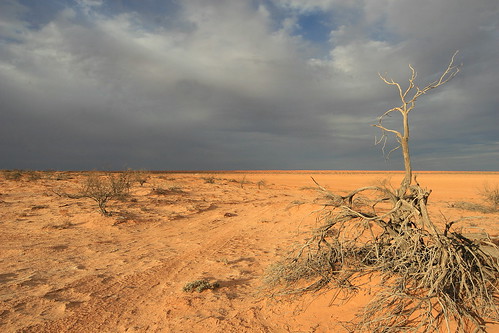
We spent that night near Peoppel's Corner after playing the customary, "I can stand in three states at once" game and taking it in turns to pose for photos. The morning brought spectacular light peeping through storm clouds and highlighting the textures on the dune and saltpan.
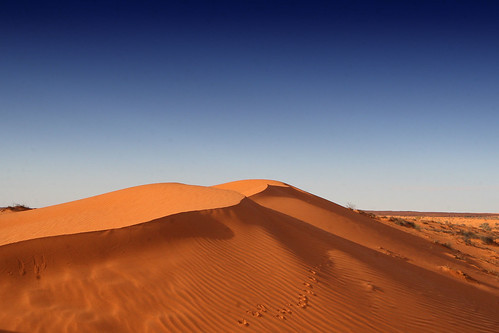
Heading up the QAA line we came across an amazing dune, perfectly sculptured, beautifully lit by the low morning sun and tracked by a dingo, birds and lizards. We stopped for some time at the top, playing with the wideangle lens. The red dune and blue sky made for wonderful pictures.
More dunes, alternating with empty saltpans - a couple of big dunes, some suprisingly with flowering plants, but for the most part the vegetation was restricted to occasional gidgee trees.
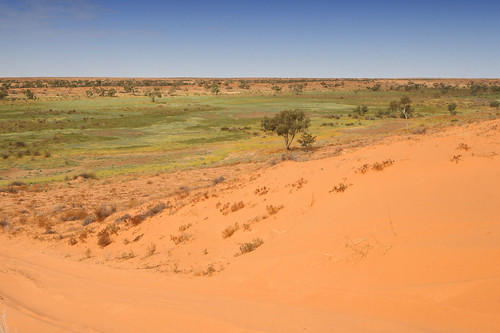
Then, about 5 or 6 kms past the rabbit fence, we came over the top of a dune to see a veritable 'meadow' spread out before us - grass, flowers, trees ...
Bird list:
Eyrean Grasswren
White-winged Fairywren
Crested Bowerbird
Brown Falcon
Dalhousie Springs

Though the red sand dunes were seemingly endless the national park also contains salt lakes, tracts of spinifex and gidgee woodland and, wherever moisture collected, stunning and unexpected bursts of colourful wildflowers. At the springs, natural and planted native trees and shrubs along with the date palms gave an oasis feel, and clean modern facilities provided a touch of luxury. This was a popular camping spot, with many people visiting the springs who were not continuing to cross the Simpson.
Bird list:
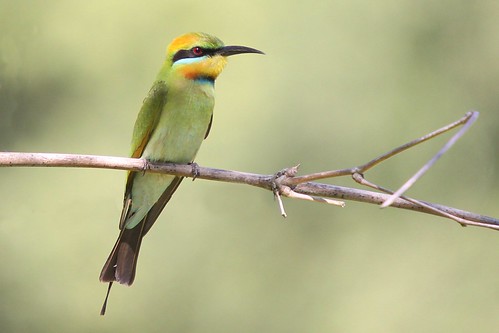
Rainbow Bee-eater (Pictured above)
Australian Grebe
Variegated Fairywren
Grey Fantail (Pictured above)
Welcome Swallow
Hardhead
Zebra Finch
Purni Bore
By the time we reached Purni Bore, it was hot, there were thousands of bush flies in my ears, up my nose and filling the space between my eyes and my sun glasses. (I have a number of photos that feature extreme close-ups of the flies). Alwyn went birding and was rewarded with great photos of an Australian (Spotted) Crake and a Spotless Crake. I sat in the shade of the tank-stand where a juvenile western gerygone came obligingly close, pecking on the ground under an acacia, and trillers stayed out of camera range in the shrubs.
The bodies of two camels lay together just off the road. Unfortunately the only camels we saw on the trip were dead or captive.
Overnight I heard a noise outside and looked out of the tent to see a dingo 2 metres away. He had found something to eat in the ashes of a previous camper's fire, and stood there for some minutes finishing his snack.
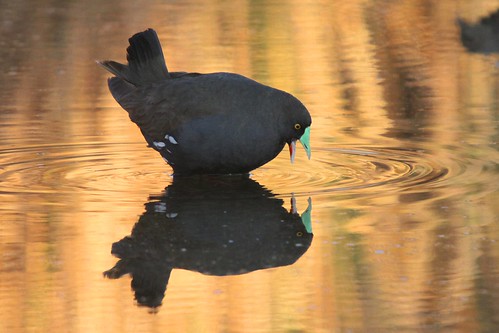
The morning dawned cool and clear. Just on first light my dingo howled nearby, and was answered by another in the dunes - their conversation continued for some moments. Wonderful! A light mist hovered over the billabong and the early morning light reflected off the reed beds turned its surface to liquid gold. A large group of native hens went about their business, galahs and corellas filled the trees and ducks floated motionless in imitation of pool ornaments.
Purni Bore is the result of drilling by the French Petroleum Company in 1963. It was capped and sealed when they abandoned oil exploration, but over time the wellhead corroded and water flowed out of the bore at a rate of up to 18 litres per second, creating an artificial wetland. The bore was capped in 1987 when the excessive flow was found to be affecting the flow of the nearby Dalhousie Springs. Travellers used to be able to swim at Purni Bore, but since the water flow was reduced reeds have grown along the bore drain. Now a sufficient flow is maintained to sustain the wildlife that has come to rely on this permanent water source. We saw footprints of dingoes, kangaroos, wallabies and camels, and many lizards and small mamals.
Water flows out of the borehead at 85C. Almost hot enough to make tea!
Bird List:
Black-tailed Native Hen
Australian Crake
Grey Teal
White-headed Stilt
Black-fronted Dotterel
Spotless Crake
White-winged Triller
White-winged Fairywren
Western Gerygone
Galah
Little Corella
Mt Dare
Budgerigars (by Alwyn).jpg)
Crested Pigeons (by Alwyn)
We met up with the others at Mt Dare, to start the Simpson Crossing. A steak dinner, a catch up with the various travel experiences of the others and cultivating the friendship of Chester, the hotel dog, occupied the evening. We gained agreement to a late-ish start so that we could do some birding at the dam and bore overflow at first light. Our efforts were well rewarded.
Huge flocks of budgerigars, galahs, zebra finches, corellas and red-tailed black cockatoos perched on every available tree waiting a turn at the water. White-breasted and black-faced woodswallows circled and returned to favourite branches. Honeyeaters fed on the garden shrubs. My laptop died before I had copied more than 4 of 14 folders to an external hard drive, I was able to recover the files from the card in the 30D with the wide angle, but not from the 50D which I was using for bird photography. So most of my birds from the trip are gone. I've posted some from Alwyn here to give an idea of the feast and famine situation with birds in the desert. Find water and you'll find birds.
Heading to Dalhousie Springs, we stopped at Blood's Creek and then at 3 O'Clock Creek. At Blood's Creek we saw yet another flock of Zebra Finches - these are tough little birds, able to eke out a living in the most arid landscapes. Blood's Creek was an important waypoint for both the Overland Telegraph and the Ghan Railway. In 1901 the Government put down a 2002 ft bore and a giant windmill which still spins slowly today, though there is little water available on the surface. Legend has it that when a traveller died here, they only had enough whiskey crates to make a short coffin with an open end and had to bury the man with his legs sticking out of the end of the box.
We stopped at 3 O'Clock Creek for a closer look at the Red Mulga or Minniritchi (Acacia cyperophylla). Also in the area were Coolibah, mentioned in Waltzing Matilda, Witchety Bush, amongst whose roots the tasty grubs can be found and Dead Finish, a wattle with such survival skills that it is said that when it dies everything is over.
Fairywrens and grasswrens flittered amongst the spindly shrubs.
Bird List:
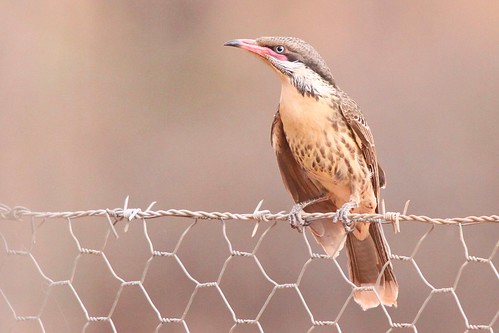
Spiny-cheeked Honeyeater (pictured above)
White-plumed Honeyeater
Budgerigar
White-breasted Woodswallow
Black-faced Woodswallow
Galah
Red-tailed Black Cockatoo
Corella
Zebra Finch
Magpie Lark
White-bellied Cuckoo-Shrike
Willie Wagtail
Australian raven
Crested Pigeon
Diamond Dove
Australian Magpie
White-winged Fairywren
Eyrean Grasswren
Brown Falcon
Grey Fantail
Monday, September 7, 2009
Eringa Waterhole
Australian Hobby - Race murchisonianus, originally uploaded by alwynsimple.
We arrived in Oodnadatta to find that the guy who ran the tyre service at the Pink Roadhouse was away for the weekend, he'd be back Monday - or maybe Tuesday. So we did a quick trip to Coober Pedy; a few beers in an underground bar, a night in a caravan park, early morning repairs by a very obliging garage and back to Oodnadatta. At least it gave us the opportunity to see the Moon Plain (where films like Mad Max, Priscilla and Pitch Black were filmed) and Coober Pedy though we no longer had time for the Painted Desert.
Back to Oodnadatta then across Fogarty's Claypan without incident as it was conveniently somewhere in between too wet and too dry. Ponds along the road dug to support roadworks attracted clouds of zebra finch and flocks of diamond doves.
We had been following a bicycle track for some time, and caught up with the rider at Eringa Waterhole. It would have been interesting to find out his story - bicycling through the Simpson is hardly a mainstream activity, but he wasn't inclined to chat.
The explorer John McDouall Stuart camped at Eringa during his trips in the 1860’s, but long before this it was a significant area in Aboriginal mythology. The waterhole was part of the holdings of the ‘cattle king’, Sir Sidney Kidman, and the ruins of a house, a rainwater tank and a meathouse built during the Kidman era were interesting to explore. With the permanent water and majestic white-trunked gum trees, it was a very pretty spot.
Bird list:
Australian Hobby - Race Murchisonianus (pictured above by Alwyn Simple)
Western Shrike -Thrush
Australian Raven
Cockatiel
Yellow-throated Miner
White-plumed Honeyeater
Wedge-tailed Eagle
Black Kite
Galah
Diamond Dove
Zebra Finch
Australian Magpie
White-breasted Woodswallow
Black-fronted Dotterel
Australian Grebe
Magpie Lark
Pied Butcherbird
Willie Wagtail
Whistling Kite
Black-Faced Cuckoo-Shrike
Algebuckina Waterhole
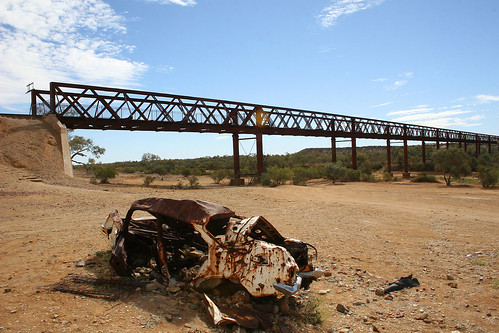
The waterhole east of the bridge looked inviting, but the river wasn't flowing, though apparently at times it can run a mile wide. The imposing bridge looked a little incongruous above the gravel river bed.
The nineteen iron sections of the bridge were constructed in Scotland and shipped out in 1890 to Adelaide, then transported to this remote spot. While most of the bridge is fenced, you can walk a little way onto it, and read the information on its history. Rusting vehicles, old graves, and the remains of railway buildings make it an interesting place to explore.
Bird List:
Inland Thornbill (pictured above)
Wedge-tailed Eagle
Brown Falcon
Red-backed Kingfisher
Fairy Martin

.jpg)
.jpg)