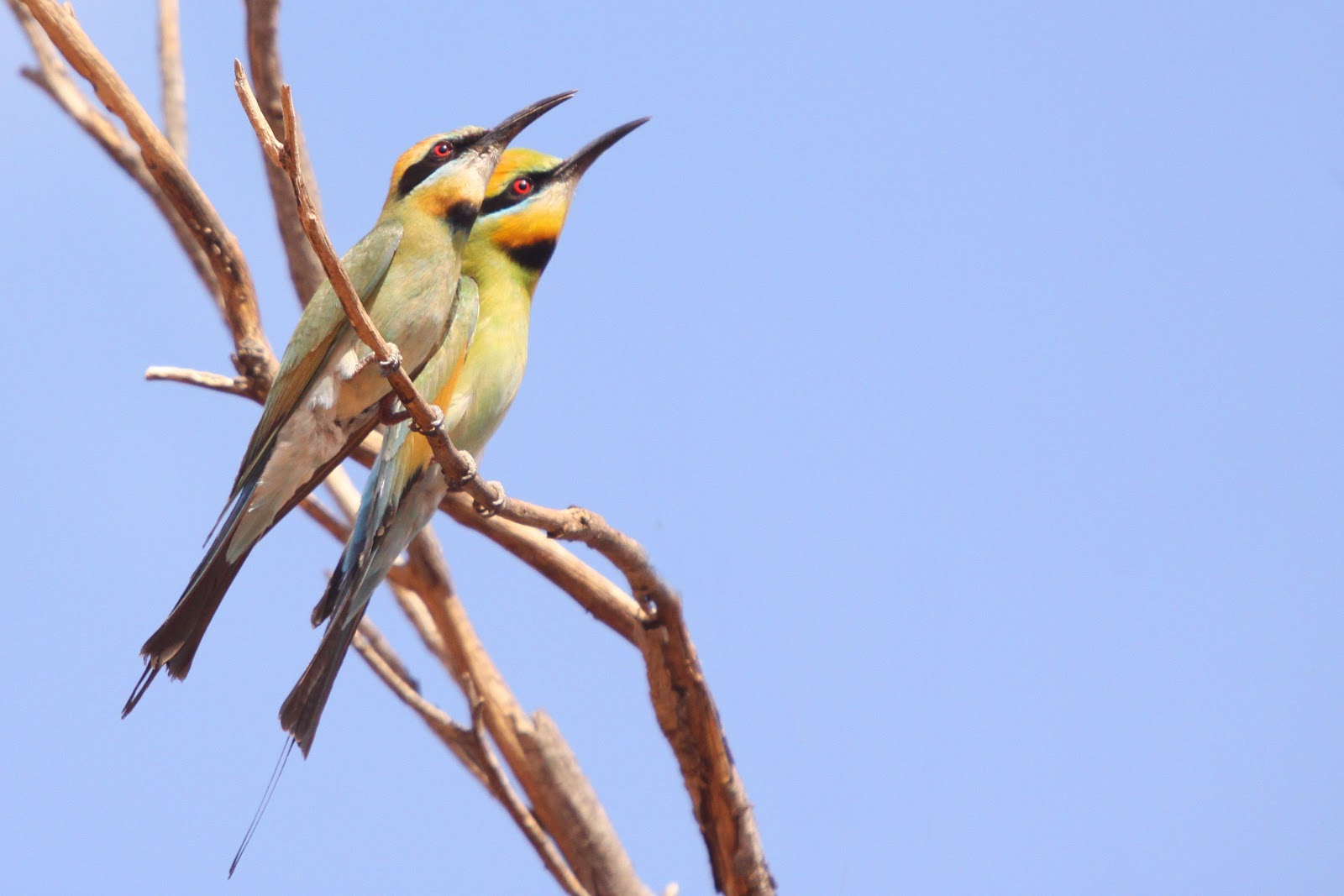
Courtship routine of the Red-backed Fairywren, in the twiggy shrubs across from the Roebuck Roadhouse. They were constantly on the move, and quite distant, but it was great to see how the male fluffed up his head feathers and displayed the wonderful red feathers in a birdy cape.
Thursday, October 14, 2010
Monday, October 11, 2010
Roebuck Bay
Photo tips from Craig Ingram, our instructor.
- Use a tripod, to maximise sharpness.
- Use aperture priority mode, to give maximum shutter speed for the situation.
- Use AI servo mode, to keep a moving subject in focus.
- Expose to the right of the histogram, to maximise quality.
- Use auto white balance and adjust in post-processing.
- Remember that the quality of the light is the life blood of the image.
- The frame boundaries are the primary tool in composition, be decisive about what is in and what is out.
Two Dog Hermit
Our morning workshop on the 7th was at Two Dog Hermit, where large mixed groups of waders gather on the off-shore rocks as the mud flats disappear under the incoming tide before moving to the beach.
A sea research team from the Netherlands identified over 280 different mud creatures from thin the Roebuck Bay tidal flats. The waders stick close to the edge of the tide as they feed, following the bivalves that are close to the surface at the water’s edge, but bunker down deeper into the mud as the tide recedes.
Eventually, as the tide brings lunch to a close, birds can catch a quick nap.
But instead of simply moving higher on the beach they were feeding on, they strangely commute up to 120kms a day between shady roost sites and the exposed mud flats. Beaches that held huge flocks the day before, may be empty the next day.
As the tide gets higher the hide tide mark is too close to the cliffs for the birds to relax. This day the birds were edgy, with flocks arriving and leaving alternately. The ten metre tide eventually lapped against the edge of the Pindan cliffs, and the birds had gone, perhaps to the plains or the wetlands of the sewerage ponds.
One Tree
Next day the high tide was a little later in the morning, so we went to One Tree to look for birds in the mangroves and get images of individual waders feeding on the mud flats.
First bird of the day was a broad-billed flycatcher, moving between three favoured perches to sing in the early morning light, followed by a mangrove grey fantail who proved more of a challenge to capture as he constantly flittered through the mangroves. White-breasted wood-swallows perched in the dead trees on the other side of Crab Creek, and yellow white-eyes were in abundance.
In George Swan’s guide to birding the area, he recommends birding the Big Crab Creek trail close to a neap tide as you need to cross Little Crab Creek and you will get stranded on a higher tide. He also gives specific instructions on where to cross Little Crab Creek to avoid the deepest mud. We crossed in plenty of time, and for the most part we stayed out of the mud. We were given specific instructions to be back at the creek crossing within 30 minutes, and divided up into ones and twos to creep up on individual birds feeding. It was a successful morning, with the valuable lesson learned that “40 minutes” isn’t really close enough to “30 minutes”. We had to go further upstream to cross Little Crab Creek and ended up knee deep in mud and thigh deep in water, ferrying cameras and tripods over our head. My shoes stuck in an underwater mud bank, and I left them there.
But using our newly learned birding and photography techniques, we did capture some great images of the waders.
Ruddy Turnstone
Black-tailed Godwit
Friday, October 8, 2010
Horse Pond
Campsite Beach
I happened to choose well and was rewarded with some images of the huge number of waders that spend the summer on the shores of Roebuck bay.
Some of the birds are still showing their breeding colours. After a period of watching them closely they started to develop distinct personalities. The terek sandpipers are busy birds, even when others are closing their eyes they are still pottering about. The greenshanks are nervy, first to scatter as a white-breasted sea eagle, brahminy kite, or whistling kite flew overhead.
Tuesday, October 5, 2010
Broome Bird Observatory
The tour gave us a full day on Roebuck plains station, which involved a range of habitat including tropical wetland, pindan woodland and grassland, and the microhabitats around natural waterholes and man-made bore dams.