Showing posts with label Acanthizidae. Show all posts

Sunday, October 14, 2012

Avisford Reserve

IMG_1576_1

Double-barred Finch

Avisford Nature Reserve is on the south west corner of Mudgee, with new housing developments moving closer every day. Accessed via Waterworks Road, it covers an area of 2,437 hectares and includes Redbank Creek Dam, which was built in 1899 as a water supply for Mudgee but now does not hold water, apart from a small weir pond at the entrance.

Avisford Nature Reserve protects areas of relatively high ridgelands typified by steep
sloping gullies and hills with open forest and woodlands. These ridgelands provide habitat for diverse fauna and flora populations. The Reserve contains the Capertee stringybark, a tree with a limited geographical range, and seven animal species listed as vulnerable.

A comprehensive fauna survey was completed by the NPWS during July 2002. The area is a particularly diverse refuge for avifauna with the NPWS Atlas of NSW Wildlife listing 161 diurnal bird species as being recorded either in the Reserve or within 10 kilometres of the Reserve. Species from the families Acanthizidae (scrub wrens, thornbills and warblers) and Muscicapidae (flycatchers, robins and allies) are most common and include the Whitebrowed Scrub Wren (Sericornis frontalis), Weebill (Smicrornis brevirostris), Speckled Warbler (Pyrrholaemus sagittatus) and Jacky Winter (Microeca leucophaea). These species tend to frequent moister and more open lower slope or gully forests (white box – apple box alluvial or blue leaved stringybark open forest sites). The honeyeaters (family Meliphagidae) are another particularly diverse group frequently recorded within the Reserve and include the White-eared Honeyeater (Lichenostomus leucotis), Eastern Spinebill (Acanthorhynchus tenuirostris) and White-naped Honeyeater (Melithreptus lunatus). Nocturnal bird species including the Southern Boobook (Ninox boobook) and Powerful Owl (Ninox strenua) are also present in the Reserve.

No dogs allowed, so we made a couple of short visits in the cool of the morning and evening when we could leave the dogs in the car. On arrival in the late afternoon a group of Glossy Black Cockatoos flew over screeching. Double-barred finches and Red-browed Finches enjoyed the last of the sun, Superb Fairywren and White-browed Scrub Wrens twittered from the undergrowth. A young Grey Butcherbird practiced its vocalisations. It took us a moment to identify a Common Blackbird, an ‘undocumented immigrant’ that we don’t see often around our way. Noisy Friarbirds, Eastern Spinebills and White-naped Honeyeaters represented the Meliphagidae.

IMG_1604_1

White-naped Honeyeater

Next morning we were greeted by the call of a Fan-tailed Cuckoo. The tiny birds were out in abundance: Silvereyes, Red-browed and Double-barred Finches, Striated Thornbills and the Fairywrens and Scrubwrens.

039_1

Walking along the creek bed, I had a Spotted Pardalote fly out of a burrow almost at my head. It perched glaring at me until I moved away. A number of Red Wattlebirds played a noisy game, and Pied Currawongs swooped and called through the upper branches. Rufous Whistlers added their song to the mix.

059_1

A pair of Galahs worked at enlarging a hole.

It will be interesting to see how the reserve develops under National Parks administration. At the moment it is fairly overrun by feral animals: rabbits, goats and foxes are common. In the middle of the year someone cut down over one-hundred trees in the reserve. But it is safe from leashed dogs.

Thursday, December 22, 2011

The Neck, Bruny Island

IMG_8647_1
IMG_8663_1
The rain was as short-lived as it was heavy, and we were able to get the cameras out again at the Neck. On the Isthmus Bay side Silver Gulls, Kelp Gulls and Pied Oystercatchers foraged in the shallows. Superb Fairywrens bustled about among the Fairy Penguin burrows, but the adults were out to sea and the young stayed tucked up in the burrows. A Tasmanian Scrubwren scolded us from its bush beside the boardwalk.
IMG_8676_1
IMG_8678_1

Tuesday, November 9, 2010

Budgewoi

Map picture

This little ‘lagoon’ of abandoned roadway is a great spot for walking the dogs, out of the mud that is most of the parks and reserves around here at the moment, with dense bush on both sides, and a swim in the surf at the turnaround point.

With the rain, the move and the end of semester marking and admin, there has not been a lot of time for bird photography, but the rain had been replaced by high cloud, so I took the camera out with us this afternoon.

011_1

The mistletoe was in bloom, attracting newholland honeyeaters, and the brown thornbills were in every bush. Whipbirds called from deep in the undergrowth and red-whiskered bulbuls were feeding on the lantana. Variegated fairywren females flew in to investigate my phishing, but the brightly coloured males kept their distance.

052_1

072_1

093_1

134_1

Wednesday, July 21, 2010

Hi Fert

051_1

Bar-shouldered Dove

030_1

White-browed Scrub Wren

Back on our home turf at HiFert on Kooragang Island, the dogs happily followed scent trails on the grass while the scrub wrens scolded from the bitou bush. The resident group of bar-shouldered doves had found spilled grain by the side of the road, and a group of around thirty red-browed firetails satisfied themselves with grass seeds.

The male superb-fairy wrens were resplendent in their breeding plumage. Willie-wagtails and grey fantails were hawking for insects, and yellow thornbills and silvereyes hid in the casuarinas. Brown honeyeaters and a single red wattlebird called from the banksias.

A young white-bellied sea eagle cruised overhead, little inconvenienced by the screeches of the masked-lapwing. White and straw-necked ibis pecked over the boggy areas.

Over the river were great crested terns, silver gulls and Australian pelicans while little pied and little black cormorants floated on the surface.

Saturday, April 10, 2010

Black Spring TSR

On Easter Saturday, a walk through the Black Spring TSR was hot and dusty. It is a remnant of the once vast Grassy White Box Woodland that covered the area, and runs alongside the road about 6.5k south of Barraba. Maureen and I trudged the 3k to the end without coming across water in any of the three waterholes. Heading up to the top of the ridge we were snapping Mistletoe birds when a  Speckled Warbler came down to scold us. It followed us as we worked our way uphill.

IMG_8461_1Mistletoebird - female

IMG_8425_1

Speckled Warbler

A number of tiny birds were chasing insects in the top of the eucalypts. Buff-Rumped and Yellow-Rumped Thornbills, White-Throated Gerygone and Weebills.

IMG_8526_1Weebill

Australia’s smallest bird, Weebills are a bit of a challenge for photographers, as they move fast high in the trees. I managed to get my best shots yet of the little cutie. On the way back to camp we stopped to watch several Jack Winter catching insects on a large mistletoe clump.

IMG_8304_1Jacky Winter

Monday, March 15, 2010

Wambina Nature Reserve

065_1
Brown Thornbill
096_1
Brown Gerygone
051_1
Silvereye
031_1
Red-browed Firetail
902_1
White-throated Treecreeper
The 53 hectare Wambina Nature Reserve  protects the headwaters of Erina Creek. It covers a variety of habitats from ridges of open forest to deep rainforest gullies. The reserve provides habitat for flying foxes, powerful owls and southern angle-headed dragons.
It is one of a series of reserves and parks stretching along coastal New South Wales, which provide habitat for a range of migratory and nomadic animals. It is also provides a link to other reserves on the Central Coast, such as Katandra and Rumbalara, which are managed by Gosford City Council. The vegetation includes warm temperate rainforest with sub tropical elements; and open forests of Blackbutt Eucalyptus pilularis, Spotted Gum Corymbia maculata and Sydney Blue Gum Eucalyptus saligna. Twelve animal species found in the reserve are listed as Vulnerable.
It was a day for little brown birds when we visited. Many Superb Fairywrens, Eastern Yellow Robins, and White-browed Scrubwrens as well as those pictured above.

Monday, September 7, 2009

Algebuckina Waterhole


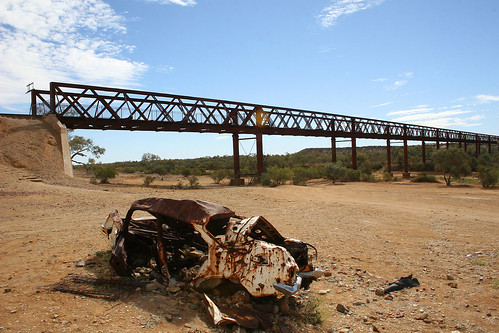
We got our first puncture when we pulled off the road to see Plane Henge, and the second when we pulled over for a closer look at the Algebuckina Waterhole and the iron bridge over Neale's River. We had been warned about the sharp stones on this section of the track. There was nothing much I could do, and there was a lot of swearing near the vehicle so I climbed up onto the bridge and wandered along the edge of the watercourse. A brown falcon flew off from the top of the bridge, and a wedge-tailed eagle soared high overhead. Thornbills twittered in the trees. The cliff face held kingfisher nests and fairy martin were adding to their mud tunnels under the cliff overhang.

The waterhole east of the bridge looked inviting, but the river wasn't flowing, though apparently at times it can run a mile wide. The imposing bridge looked a little incongruous above the gravel river bed.

The nineteen iron sections of the bridge were constructed in Scotland and shipped out in 1890 to Adelaide, then transported to this remote spot. While most of the bridge is fenced, you can walk a little way onto it, and read the information on its history. Rusting vehicles, old graves, and the remains of railway buildings make it an interesting place to explore.

Bird List:

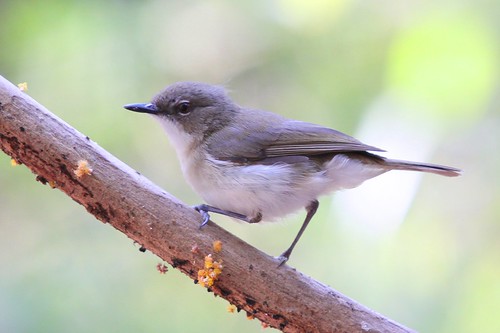
Inland Thornbill (pictured above)
Wedge-tailed Eagle
Brown Falcon
Red-backed Kingfisher
Fairy Martin

Thursday, August 20, 2009

Broken Hill


We left our camp by sunup, and stopped for breakfast at Cobar, right on the edge of town where a small dam offered a range of birds. Whiteface and babblers shared a treestump, cockatoos and corellas screeched in to drink. Dozens of martins circled us.


Just past Wilcannia we came across a flock of more than 200 Red-tailed Black Cockatoos feeding on the ground beside the road. They apparently change food sources depending on the seasons, feeding on Sheoak seeds, White Cedar fruits or the seeds of weeds such as Storksbill and Cathead.

And then on to Broken Hill and the Desert Park. An amazing place - the Living Desert Sculptures on top of the ridge were spectacular in the late afternoon light, and the bird and animal life could have kept us occupied for hours.

Bird list:

Chirruping Wedgebill (pictured above)
Yellow-throated Miner
White-backed Swallow
White-winged fairywren
Singing Honeyeater
Spiny-cheeked Honeyeater
Orange-breasted Chat
Tree Martin
Southern Whiteface (Pictured above)
White-browed Babbler
Pied Butcherbird
Apostlebird
Australian Raven
Galah
White-winged Chough
Ringnecked Parrot
Sulphur-crested Cockatoo
Major Mitchell Cockatoo
Black-fronted Dotterel
Blue-faced Honeyeater
Crested Pigeon
Little Corella
Willie Wagtail
Emu
Red-winged Parrot
Australian Pipit
Australian Kestrel
Red-tailed Black Cockatoo
Black Kite
European Starling

Tuesday, August 4, 2009

Stockton Channel

Yellow-rumped Thornbill


Australian Hobby

We were up particularly early this morning - probably as a result of falling asleep in front of the television. So I walked the dogs in the dark, and grabbed the camera from the car just as the sun rose.

A large group of thornbills were chirping in the mangroves and I was attempting to capture them in the very poor light when a hobby flew onto a sunlit perch beside me. He could have positioned himself a little better, but he perched there for some time much to the consternation of the thornbills, which immediately became still and quiet.

The hobby is one of Australia's smallest raptors. They will hunt small birds, up to nearly their own size. The yellow-rumped thornbill is one of the more common thornbills, identifiable by its spotted head as well as its yellow rump.

I stopped in at Stockton Sandspit, and came across the Hunter Bird Observers Club, gathering for their Tuesday walk. I chatted for a moment, but we had been out for two hours and a hot breakast was marginally more appealing than more walking.

Bird list:

Australian Hobby (pictured above)
Yellow-rumped Thornbill (pictured above)
Black Swan
Little Black Cormorant
Australian Pelican
White faced Heron
Great Egret
Australian White Ibis
Superb Fairy wren
Little Wattlebird
Black-faced Cuckoo-shrike
Magpie Lark
Willy Wagtail
Feral Pigeon
Brown Honeyeater
Spur-winged Plover

Sunday, August 2, 2009

Werekata National Park


Today Maureen and I took part in the annual Regent Honeyeater and Swift Parrot survey. We were given an area to cover on each side of Sawpit Road, Kitchener and arrived at 8:00am to spend two hours systematically covering the area, and filling in our form.


The frost on the ground was a bit of a shock to us coastal dwellers, but it soon warmed up into a beautiful, spring-like day. There were stringybark and spotted gum in flower and good numbers of wattles in full bloom attracting insects. It looked promising.


Since European settlement 30% of Australia’s woodlands, and 80% of temperate woodlands, have been cleared with devasting consequences for woodland birds. The Swift Parrot and Regent Honeyeater are mobile nectar feeders that prefer the lowland woodlands that support the richest sources of food, so they have have suffered the effects of clearing more than many and are nationally listed as Endangered. Habitat Restoration Projects will benefit not only the target species but also other threatened species including threatened bird species including the Speckled Warbler, Turquoise Parrot, Little Lorikeet, Painted Honeyeater, Brown Treecreeper, and Superb Parrot.


Data from the surveys, which have been undertaken for fifteen years, is being used for a range of research projects such as studies to improve our knowledge of migration, environmental requirements, and climate change impacts.


We had a very successful day, except for not seeing any Regent Honeyeaters or Swift Parrots. We thought we saw two Regents in flight, but could not confirm the ID. Swifties eluded us altogether.


Bird List:

Buff-rumped Thornbill (pictured above)
Noisy Friarbird
Red Wattlebird
Noisy Miner
Yellow-faced Honeyeater
White-naped Honeyeater
Lewin's Honeyeater
Bell Miner
Eastern Spinebill
Fuscous Honeyeater
White-cheeked Honeyeater
Yellow-tufted Honeyeater
Galah
Eastern Rosella
Rainbow Lorikeet
Little Lorikeet
White throated Treecreeper
Superb Fairywren
Variegated Fairy wren
Speckled Warbler
Yellow Thornbill
Australian Magpie
Pied Currawong
Eastern Yellow Robin

Sunday, July 19, 2009

Galgabba Point


Maureen and I took advantage of a perfect Newcastle winter day to visit Galgabba Point, Swansea. A great place for a leisurely walk, often rewarding the effort with good numbers of birds, the point has an interesting history. Sharon McCarthy's leadership in restoring this site is a great example of what one person can achieve.
The eucalypts had almost finished flowering, but there were sufficient blossoms to attract friarbirds, and keep smaller honeyeaters busy. The wattles were starting to flower and little birds were hunting insects in their branches.
We saw a large group of adult male mistletoebirds but like most of the birds they stayed high in the canopy and we managed only shots of their bellies from directly underneath. Thornsbills occupied us for a while as we convinced ourselves that, if we perservered, eventually one would sit still, on an exposed branch, for long enough for the lens to focus on it.
Coffe and cake at Maccas completed a morning that was a lot of fun, even if it didn't produce large numbers of photos.

Bird List:

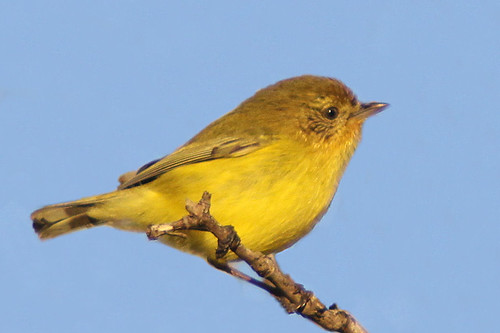
Yellow Thornbill Acanthiza nana (pictured aboce)
Australasian Magpie Gymnorhina tibicen
Magpie Lark Grallina cyanoleuca
Rainbow Lorikeet Trichoglossus haematodus
White-cheeked Honeyeater Phylidonyris nigra
Australian Pelican Pelecanus conspicillatus
Superb Fairywren Malurus cyaneus
Red-browed Firetail Neochmia temporalis
White-browed Scrubwren Sericornis frontalis
Willie-wagtail Rhipidura leucophrys
Gray Fantail Rhipidura fuliginosa
Brown Honeyeater Lichmera indistincta
Bell Miner Manorina melanophrys
Golden Whistler Pachycephala pectoralis
Rufous Whistler Pachycephala rufiventris

Monday, June 22, 2009

Howard Springs Nature Park


Today's excursion was to Howard Springs. In the wet season this is a good spot for Magpie Geese, Whistling Ducks, Radjah Shelducks and Pygmy Geese, however today the dominant species was the Little Corella. Dozens of the birds were calling from the trees around the spring-fed pool at the picnic ground.
Our first sighting was a Lemon-bellied Flycatcher. This is becoming the iconic bird of the trip - popping up wherever I go and posing on well lit perches like an entrant in America's Next Top Model - yes, lovely ... put one wing on your hip please ... gorgeous!
The highlights included a pair of Shining Flycatchers foraging in the leaf litter and chasing one another away from the best bits, and the Large-billed Gerygone who perched in a perfect spot for a photograph.
Bird List:
Large-billed Gerygone Gerygone magnirostris (pictured above)
Australian White Ibis Threskiornis molucca
Black Kite Milvus migrans
Pied Imperial-Pigeon Ducula bicolour
Red-tailed Black-Cockatoo Calyptorhynchus banksii
Galah Cacatua roseicapilla
Little Corella Cacatua sanguinea
Sulphur-crested Cockatoo Cacatua galerita
Rainbow Bee-eater Merops ornatus
Striated Pardalote Pardalotus striatus
Large-billed Gerygone Gerygone magnirostris
Lemon-bellied Flycatcher Microeca flavigaster
Shining Flycatcher Myiagra alecto
Varied Triller Lalage leucomela
White-bellied Cuckoo-Shrike Coracina papuensis
Mistletoebird Dicaeum hirundinaceum

Friday, June 12, 2009

HiFert, Kooragang


We finally have sunshine after three weeks of rain, but it has come with freezing gale-force winds. Even the birds are huddled up for warmth. There were large flocks of tiny birds at HiFert today; silvereyes, thornbills, fairywrens. The Swamp Harrier was cruising the mangroves and the brown honeyeaters were controlling the coral tree.
Bird List:
  • Yellow Thornbill Acanthiza nana (pictured above)
  • Swamp Harrier Circus approximans
  • Willie-wagtail Rhipidura leucophrys
  • Brown Honeyeater Lichmera indistincta
  • White-browed Scrubwren Sericornis frontalis
  • Superb Fairywren Malurus cyaneus
  • Silver-eye Zosterops lateralis