|
| Brown Treecreeper |
The shrubs around our picnic table however brought in a good number of bush birds.
 |
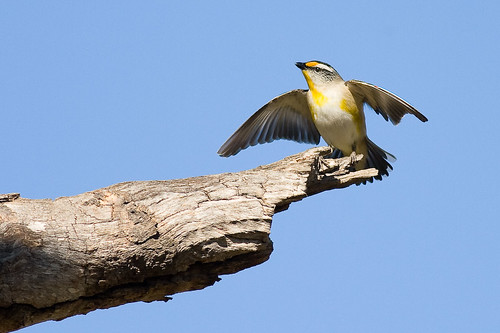
| Striated Pardalote |
 |
| White-plumed Honeyeater |
|
| Brown Treecreeper |
|
| Striated Pardalote |
|
| White-plumed Honeyeater |


The travelling stock route and reserves network (TSR network) in New South Wales and Queensland is an extensive network of public land that was established for the droving of sheep and cattle during early European colonisation, often along traditional Aboriginal pathways through the landscape. Travelling stock routes are roads along which livestock can legally be driven, and usually have wide verges on which cattle can graze. Travelling stock reserves include stock routes as well as fenced areas for camping with or watering stock overnight. Because TSRs have remained publicly owned and generally have not been cleared, many protect remnants of woodland vegetation in the otherwise highly-cleared wheat and sheep farming belts.
The administration of NSW TSRs is complex, and differs between the geographic divisions of the state. In the west the TSRs are leased by private landholders with the condition that they provide access to travelling stock. In the east the Livestock Health and Pest Authorities currently oversee management, the collection of rates and the movement of stock, and are under increasing pressure to provide a clear economic case for the value of TSRs under their care. A range of uses are permitted including picnicking and walking, but this varies from reserve to reserve. There is a concern that some TSRs may be sold to neighbouring land holders, leading to the further break-up of the TSR network, loss of access for current users and the probable loss of key network functions. The TSR Network also faces a range of other threats, including overgrazing, invasive species, firewood collection, and mining.
Travelling Stock Reserves, with remnant vegetation and permanent water, play an important role in protecting bird species whose habitat has been reduced by broad scale farming.
Declining songbirds of the NSW sheep-wheat belt:
Brown Treecreeper Climacteris picumnus
Speckled Warbler Chthonicola sagittata
Chestnut-rumped Thornbill Acanthiza uropygialis
Southern Whiteface Aphelocephala leucopsis
Grey-crowned Babbler Pomatostomus temporalis
White-browed Babbler Pomatostomus superciliosus
Varied Sittella Daphoenositta chrysoptera
Crested Shrike-tit Falcunculus frontatus
Rufous Whistler Pachycephala rufiventris
Crested Bellbird Oreoica gutteralis
Restless Flycatcher Myiagra inquieta
Jacky Winter Microeca fascinans
Red-capped Robin Petroica goodenovii
Hooded Robin Melanodryas cucullata
Eastern Yellow Robin Eopsaltria australis
Diamond Firetail Stagonopleura guttata
To get to Travelling Stock Reserve #21 head out of Mudgee towards Gulgong on the Castlereagh Highway. Pass Cullenbone Lane on the left and the TSR is on the right 0.7km further on, just before the crest of a hill. Driving over the crest there is a driveway on the left where you can safely turn to come back to the gate. Close the gate as there may be stock in the reserve. The track down to the river is rough but easily negotiated in 2WD.

Striated Pardalote

Eastern Rosellas

Red-Browed Finch

Sulphur-Crested Cockatoos

Surrounding Area

Crested Shriketit
Maureen and I haven’t managed to catch up since I got back, so today with the sun shining we decided to walk at Galgabba point, and then have lunch to celebrate our birthdays.
As soon as we arrived we say this wonderful Shriketit. He wouldn’t come over to the sunny side of the path but in all other respects he was a perfect model, striking a number of different poses and talking all the while. They must be close to breeding, but we only saw that one, and didn’t manage to catch him in the attempt to attract a female to the chosen nest site with quivering and waving wings.

 Spotted Pardalote
The Spotted pardalotes were exhibiting some breeding behaviour, however. Usually these tiny birds are at the very tops of tall eucalypts, and you can just glimpse movement as you hear their chirps. However they nest in a chamber at the end of narrow tunnel excavated in an earth bank, so at this time of year you have a chance to see them closer to eye level. These two were chasing each other through the bracken and shrubby wattle.
Steve is blogging about his birding trip up the Hunter Valley to Nundle, with plenty of birding stops on the way.
The last night in the motorhome we spent at Mt Bundy Station. A perfect end to the trip. We arrived at dusk as birds were gathering at the troughs for an evening drink. A large flock of galahs caught the last rays of the sun from the power lines. Figbirds whistled in the banyan fig under which we parked. Ducks and other water birds fringed the edge of the dams. Black and whistling kite came in to roost in the trees.
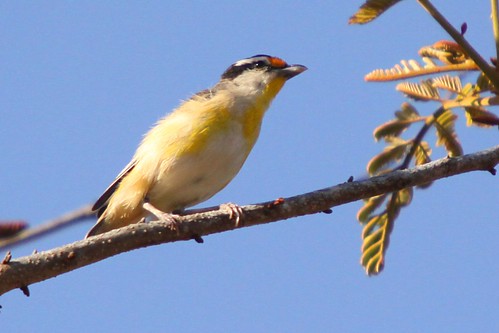
A walk next morning brought finches, flycatchers, whistlers, mistletoe birds, and pardalotes, and swallows swooping above the water and perching on the wires.
Bird List:
Black-headed Pardalote Pardalotus striatus uropygialis (pictured above)