Showing posts with label Cracticidae. Show all posts

Sunday, May 13, 2012

Toukley, NSW

079_1100_1

Having my cup of tea in the garden this morning with my camera in my lap I was surprised by a grey butcherbird who flew in to take some spiders from the bromeliads.  I don’t think of the broms as bird-attracting, but the noisy miners take nectar from the flowers and a friend who lives near the wetland has egrets regularly helping themselves to the frogs nestled in the fronds.

My target was the lorikeets – more to sharpen my reflexes than because I wanted more photos of them. They may be approaching pest proportions in the suburbs, but they certainly are colourful and highly entertaining.

196_1

207_1

Thursday, September 30, 2010

Roebuck Bay


Pied Butcherbird collecting nesting material

Our cabin is perfectly positioned on the shores of Roebuck Bay. We have a tree on our  porch which is a perch for a constant stream of birds, and a ringtail possum which sits and watches us of an evening.

An early morning walk brought brown and singing honeyeaters, little friarbirds, red-collared lorikeets, blue-winged kookaburras, pied butcherbirds, black-faced cuckoo-shrikes, little corellas, and brahminy kite.


Blackfaced Cuckoo-Shrike balancing act


Singing Honeyeater

Friday, May 28, 2010

Tarro

009_1

Indecision - “I’ll land here, no I won’t, yes I will, no I won’t”

161_1

Duck!

180_1

He seemed to be managing OK with half his top beak missing.

Saturday, December 5, 2009

Tighes Hill

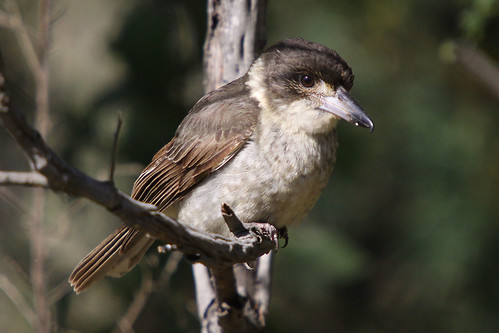
The Grey Butcherbirds have again raised young in my yard. Two babies were hopping about this morning making their first attempts at feeding themselves.

I love having these guys around. Apart from the fact that they clean up all those huge spiders that like to construct their webs across the paths, butcherbirds have one of the most melodic songs of all Australian birds. They sing in harmony too - with the song started by one bird and completed by another, so perfectly coordinated that it sounds like a single bird.

The young birds remain in the territory for around a year, helping the parents raise the young of the following year before establishing families of their own.

They get their name from their habit of storing uneaten food (lizards, mice, birds) in the forks of branches or impaled on thorns. They have adapted well to city living and are common in the suburbs.

Wednesday, November 11, 2009

Nyngan, NSW


Originally intending to drive on to Cobar, we stopped at Nyngan to check birds in the riverside park. The sun was out, the birds were in abundance, and the next-door, dog-welcoming caravan park beckoned. We pitched our tents beside the river, tired the dogs with a quick fetch/swim game and went for a walk.

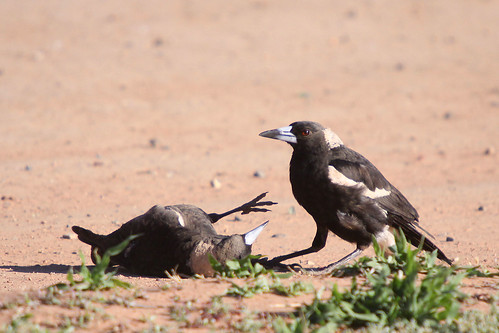
When I spotted these two young Australian Magpies I thought one was injured, but it turned out they were playing like a pair of puppies.

Play is much better understood in mammals than in birds, but birds exhibit a range of play behaviours including object manipulation (tosss and catch), acoustic activities (wierd noises), locomotory play (funny walks) and social play. The corvids exhibit the most complex play known in birds, and these activities are probably part of the learning process for young birds, helping them to adapt to a wide range of situations.

Ficken's study found patterns in the types of avian play consistent with that of mammals. She concluded that orders with mostly altricial species tend to exhibit more play, especially social play, than do orders with precocial species, and that object play is most common play behaviour, especially in raptors.

Ficken, Millicent S. "Avian Play" The Auk, Vol. 94, No. 3 (Jul., 1977), pp. 573-582