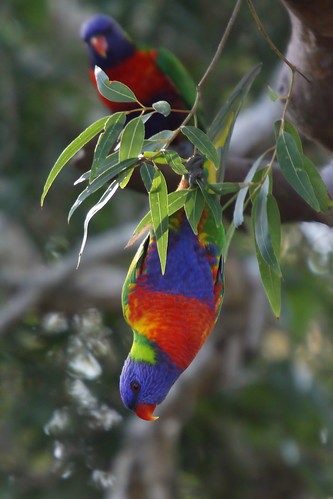
The gymnasts of the birding world at play in my garden.
Monday, April 4, 2011

Sunday, April 3, 2011
Toukley


I’m not big on feeding birds artificially, and have planted lots of flowering trees and shrubs to give them natural food sources, but when picking up dog food I noticed some Wild Lorikeet nectar mix and bought a bag. I put a small amount out yesterday and the resident noisy miners were rather appreciative, and were joined by half a dozen rainbow lorikeets. I took the empty dish away after an hour.
This morning I put some nectar out at around 6:30 am, and came back to get some over-ripe banana and a handful of grapes. By the time I got back to the garden there would have been a hundred lorikeets in the trees, lined up on the fence and taking their turn at the feeders.
The food was all gone within the hour. So I’ve removed and cleaned the dishes. While diseases can be carried by shared feeding dishes, and food can ferment and affect the birds, there seem to be no ill effects from a well managed feeding program.
Monday, March 28, 2011
Tuggerah STW

Bell Miner takes a drink

Young Lewin’s Honeyeater

Grey Fantail

Characteristically shy Whipbird

Silvereyes

Golden Whistler

Brown Thornbill
A late afternoon walk beside the Tuggerah sewerage ponds had the sun in the wrong position for photographs of Swamp Hens, Pacific Black Ducks, Chestnut Teal, Australasian Grebe, Hoary Headed Grebe, Black Swans and Welcome Swallows on the water, but the fringing bush held a good number of birds.
Monday, March 21, 2011
Dogs and Birds

As any dog-owning, bird-feeding person will attest, birds generally have nothing to fear from dogs, or at least no more than that from their human companion. Quail and Pipits will stand their ground as my disinterested dogs walk past at the local off-leash area, but flee in panic it I take a tiny step closer with the camera. But dogs do receive a good deal of bad press stemming from the behaviour of some of their naughtier representatives. Good to see them featuring in a good news story.
The Maremma dogs Eudy and Tula, pictured above, have been protecting roosting penguins on Warrnambool’s Middle Island from foxes and other predators for the past two years.
The island now provides a secure breeding habitat for about 180 adult fairy penguins, compared with just 51 penguins before the dogs took up their positions.
Friday, March 18, 2011
Soldiers Point


A bleak and rather windy day for the beach, but we stopped in at Soldiers Point at low tide to check on the migrants. No sign of any Curlew Sandpipers today, but there were quite around twenty Red-necked Stints, three Grey-Tailed Tattlers, half a dozen Ruddy Turnstones, a single Sooty Oystercatcher, four Pacific Golden Plovers and the vagrant Wandering Tattler still ambling amongst the incoming waves.
Monday, March 14, 2011
Soldier’s Point

Wandering Tattler
The Wandering Tattler is a vagrant in the East Asian-Australasian Flyway and is uncommon in Australia, although it may sometimes be overlooked, partly because of confusion with the Grey-tailed Tattler. It breeds in Siberia, Alaska and north-west Canada. The non-breeding range is around the Pacific rim where it is generally found on rocky coasts with reefs and platforms feeding in shallow pools and along the tideline. A single bird has been reported here at Soldier’s Point on and off over the last couple of months, with birds also reported at Long Reef and Newcastle Baths to the north and south.

Ruddy Turnstone
The Ruddy Turnstones are well advanced in donning their breeding plumage. They travel from their Arctic nesting grounds to coastal wintering grounds along the coastlines of every continent except Antarctica. One bird was recorded flying a 27,000 km round trip from Australia to Siberia - twice.

Pacific Golden Plover
The PGPs are only just starting to change into their spectacular breeding plumage – wish one would decide to stay, we never get to see full breeding plumage here.
The distribution of the Pacific Golden Plover is not fragmented, either in its breeding grounds or in its non-breeding areas. It breeds mostly in northern Siberia, between the Yamal Peninsula and the Chukotski Peninsula and the Gulf of Anadyr. In Australia most Pacific Golden Plovers occur along the east coast, and are especially widespread along the Queensland and NSW coastlines.

Curlew Sandpiper and Red-necked Stint
Both these birds are just starting to colour up. The breeding range of the Curlew Sandpiper is mainly restricted to the Arctic of northern Siberia. In Australia, Curlew Sandpipers occur around the coasts and are also quite widespread inland, though in smaller numbers. Many non-breeding one year old birds remain in Australia rather than migrating north during the southern winter.
The Red-necked Stint breeds in Siberia and sporadically in north and west Alaska. Unlike many of the other waders they migrate across the continent of Australia, and some first year birds move inland for the Australian winter. Migration starts in the last week of March, with most birds leaving in April.
Sunday, March 13, 2011
Dharug National Park
I have to put an extra 2,000 kms on my car by the end of the month, so took a Sunday drive to Dharug National Park, on the Hawkesbury. A very pretty drive from the Central Coast passing through farmland and rainforest pockets before winding along the river.
Unfortunately, while some areas have long been out of bounds because of Phytophthora (dieback) disease another couple of tracks were closed because of the recent discovery of Myrtle Rust in the park.
So Maureen and I hung around the picnic area at Mill Creek and walked the short Grasstree Track that followed the creek.

Highland Cattle on the riverside farmland

Masked Lapwing at the river’s edge

Young Whipbirds actually showed themselves in the low shrubs

Eastern Yellow Robin were characteristically curious

A cooperative White-eared Honeyeater gave me my best photos of this species to date.

Brush Turkeys wandered the picnic area
Subscribe to:
Posts (Atom)